
Learning Objectives
- Explain the role of music notation in preserving the music heritage in cultures that use it as a means of musical communication.
- Explain how duration and pitch are conveyed by a musical note symbol.
- Explain how duration and rhythm are represented by the shapes of the notes.
- Define and describe the function of the musical staff.
- Define pitch and identify how it is determined.
- Identify the notes on a keyboard and explain how their pattern relates to pitch.
- Define the following musical terms: accent, beat, duration, half note, half rest, eighth note, eighth rest, lines, manuscript, note, note head, quarter note, quarter rest, rest, rhythm, score, sixteenth note, sixteenth rest, spaces, staff, stave, tempo, whole note, and whole rest.
Music Notation and Duration
Music Notation
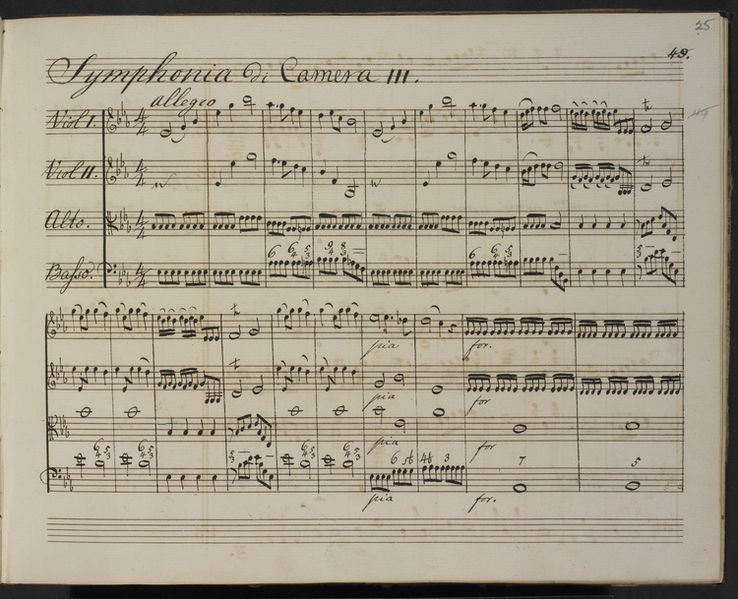
In every culture in the world, language and music have evolved. Like language, the music of a culture may have an oral as well as a written tradition. And while oral tradition in music is alive and well in almost every type of society, literate societies have developed certain systems of graphic symbols to represent sounds and the interpretation of those sounds.
In the Western music tradition, the most common way to represent sounds in written form is through the use of music notation. The image to the left depicts a manuscript of a music score, which was written using music notation. Music notation is a graphical system that strives to represent duration, pitch, and other music elements. Think of it as a blueprint, or a set of written instructions, that serves two main purposes:
- preserves the musical heritage of a people or culture and
- allows people to recreate musical works by following directions that someone else has committed to paper.
Music notation may therefore be thought of as a form of communication among musicians, and one that particularly applies between composers and performers.
In this section, we will focus on the two main components of music notation: the music symbols (e.g., notes) and the staff. Most people recognize them as elements of music notation. Many, however, believe that music notation is difficult to read. In reality, learning the basics of reading notation is not complicated.
The note symbols (or simply, the notes) and the staff convey two basic sound parameters: duration and pitch.
- The graphic representation of the symbol—its shape—conveys duration.
- The placement of a note symbol on the music staff conveys pitch. The higher the symbol is placed on the staff, the higher its pitch.
Duration of Sounds
Duration refers to the length of the sound; how long the sound lasts in time. Keep in mind that music is an art that occurs in time. The very basis of music is time organized in discrete lengths and specific intervals. Musicians must become skilled at fitting sounds together in time.
The main principle of duration in music—and the way it is written on paper—is very simple. Time values in music are expressed in relative terms. The longest value in notated music is what is called the whole note. The names of each smaller division are derived logically: half of the whole note is called a half note. Half of the half note is called a quarter note. In turn, half of the quarter note is called an eighth note, and half of the eighth note is called a sixteenth note. Therefore, it takes 2 half notes, 4 quarter notes, 8 eighth notes, or 16 sixteenth notes to make a whole note.
Time values in music are expressed in relative terms, meaning that regardless of whether a piece of music is played fast or slow (the tempo of the piece), all the note durations within that piece will be relative to each other. For instance, if the longest note in a piece is the whole note, then half notes will always last for half of that whole note, quarter notes will always last for half the duration of the half note, and so on, all in relation to the duration of the whole note—again, regardless of how slow or fast the piece is played. Seen from the perspective of time, if a whole note lasts 4 seconds, a half note played at the same tempo (speed) would last 2 seconds, a quarter note would last 1 second, and, well... you get the picture. (See the animation below for a graphic illustration of this concept). Composers decide what tempo and note values to use depending on the musical result they wish to accomplish.
The combination of duration and accent—playing sounds with more or less stress—is what creates rhythm, the essential element in music. Rhythm may be envisioned as patterns of longer and shorter durations.
The Note Symbols
Each of the five durations of notes corresponds to a different symbol. Click Show Me below to see the appearance and relative duration of each note. Each value group lasts for four beats. You may count those beats as you listen to each group.
The following table summarizes the most common note names and their symbols, including the ones that represent rests. Rests indicate periods of silence during which no notes are played or sung. Rests get the same number of beats as their corresponding note values.


The relative note lengths in the table above stop at the sixteenth note level because they are the most common in music, but the ratios continue in the same proportion. In theory, notes values could be divided in half without limit. Values shorter than a sixty-fourth note, however, are not very common because they would be very difficult to perform with any accuracy.
Note shapes consist of the notehead, the stem, and flags. The whole note is the only value represented by just a notehead. All the other shapes have a stem. In addition to the notehead and the stem, the eighth and sixteenth notes also have one and two flags, respectively.
Note Elements