Learning Objectives
- Relate the social, cultural, and political background during the Medieval period (500-1450) to the function of music during this time.
- Characterize the music of the early Christian church, i.e., Gregorian chant.
- Describe the difference between the Proper and the Ordinary of the Mass.
- Examine the influence of the Cathedral of Notre Dame as a center for organum in medieval music.
- Describe the differences between troubadours and trouvères in medieval secular music.
- Trace the rise of secular polyphonic chansons set to fixed text forms (rondeau, ballade, virelai) in the French Ars nova.
- Define and classify the instrumental music of the medieval period.
- Trace the four major developments that took place in Western music during the Middle Ages: the development of pitch and rhythmic notation; the transition from monophony to polyphony; the initial stages of regularly metered music; and the development of the motet and instrumental music.
Medieval Period (1150-1450)
Key Medieval Composers
The progression from monophony to polyphony began with the addition of a second voice to the Gregorian chant. In its simplest form, organum was the addition of a parallel part, at the distance of a fourth or fifth, to an original plainchant melody. By the 12th century, the additional melodic lines were not merely parallel additions to the original; instead, they were of greater rhythmic and melodic variety. These additional lines were based, as before, on the underlying original plainchant of the traditional Catholic liturgy.
As polyphony progressed further, composers added multiple voices with independent melodies and rhythms in relation to one another. This section highlights key historical figures in the development of polyphony.
Léonin
The French composer known as Léonin or Magister Leoninus (c. 1150–c. 1201) was associated with the Notre Dame School of Polyphony, the group of composers working at or near the Notre Dame Cathedral in Paris from about 1160 to 1250. Keep in mind that Parisians living in the late 12th and 13th centuries were witness to the construction of the cathedral, a building project that took several generations from the laying of the cornerstone in 1163. It would be fair to say that Léonin must have spent much of his career working in the cathedral, shielded from the sounds of construction by screens that perhaps shifted as the work proceeded. Most of what we know about him with any certainty, however, comes from the writings of Anonymous IV, an English theorist who worked or studied at the cathedral later in the 13th century, i.e., more than two generations after Léonin's music was written.
Léonin is best known for the development and transcription of organum (plural: organa), for his embellishment of plainchants by adding a second voice, and perhaps most importantly, for being the first composer to use rhythm in a systematic way in polyphonic music and even devise the notation to express it.
These developments, preserved in the Magnus Liber—the great book of Notre Dame—provide the first historical evidence of polyphony during the early medieval period. Pérotin allegedly revised the collection in later years.
Pérotin
Pérotin (c. 1200-c. 1236) was Léonin's successor in the later 12th century. He was also the most famous member of the Notre Dame School of Polyphony and the ars antiqua style. As polyphonic practices in Western music developed, Pérotin became active in the revision of the Magnus Liber and in the composition of organum, descant, and conductus—a type of sacred, but non-liturgical vocal composition for one or more voices.
Thanks again to Anonymous IV, Pérotin is one of very few medieval composers whose name has been preserved and can be reliably attached to specific compositions. The surviving examples of three-voice and four-voice organa by Pérotin represent a significant advance in polyphonic technique.
Composer: Pérotin
-
"Sederunt Principes"
Composer: Léonin
-
"Viderunt omnes"
Léonin, Pérotin, and the other anonymous medieval composers whose music has survived to our day are representatives of the era of European music history between approximately 1160 and 1320 that 14th-century writers called the ars antiqua (ancient art). The period covers the years of the Notre Dame School of Polyphony and the early development of the motet. The term is used in opposition to ars nova (new art), which refers to the later period of musical activity between approximately 1320 and 1375.
Hildegard von Bingen
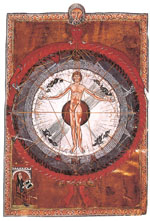
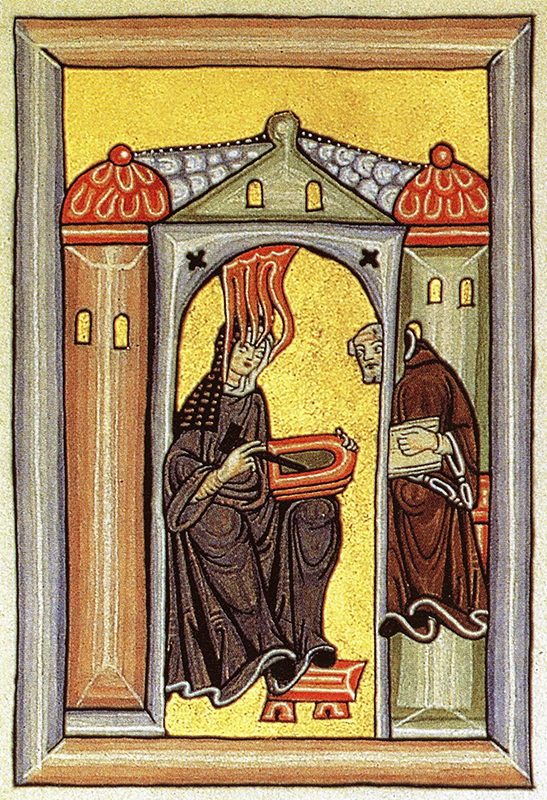
Hildegard von Bingen was born in 1098 in the German province of Rheinhessen. During her long and productive life, she held important positions as an abbess, a mystic, a diplomat, a writer, a teacher, and a composer. Hildegard became famous for her prophecies and visions, which brought her consultations with the most powerful rulers of her day. She recorded her visions in a trilogy that she assembled over a period of 30 years while also compiling treatises on medicine and natural history.
Hildegard's great musico-poetic collection was completed around the year 1150. Symphonia armonie celestium revelationem ("Symphony of the harmony of heavenly revelations") is a collection of 77 songs and one music drama, the Ordo virtutum—a morality play whose subject is the struggle between 17 virtues and the devil over the destiny of a female soul. The songs form a liturgical cycle for the church year: "Ave generosa" (with a melody that moves in mostly step-wise fashion and within a small range), "O virga ac diadema", "O viridissima virga", the Kyrie, and Alleluia honor the Virgin Mary; "Laus Trinitati", "O ignis spiritus" and "O pastor am arum" celebrate various aspects of the Trinity; and "O Euchari" and "O presul vere" are sequences praising St Eucharius and St Disibod respectively.
Composer: Hildegard von Bingen
-
"Ordo Virtutum: Procession"
Composer: Hildegard von Bingen
-
"Kyrie"
Composer: Hildegard von Bingen
-
"Ave generosa"
Composer: Hildegard von Bingen
-
"Ave generosa"
Composer: Hildegard von Bingen
-
"Alleluia, O virga mediatrix"
Composer: Hildegard von Bingen
-
"O Virga ac Diadema"
Composer: Hildegard von Bingen
-
"O Ignis Spiritus"
Composer: Hildegard von Bingen
-
"O Viridissima Virga"
Guillaume de Machaut
Guillaume de Machaut was one of the most important composers of the 14th century. In addition to being a musician, he was an accomplished poet. Machaut took holy orders and held important positions in the church. In 1323, he entered the service of King John of Bohemia as chaplain and secretary. After King John's death in 1346, French royalty and high nobility continued to lavish Machaut with honors and patronage until his death in 1377.
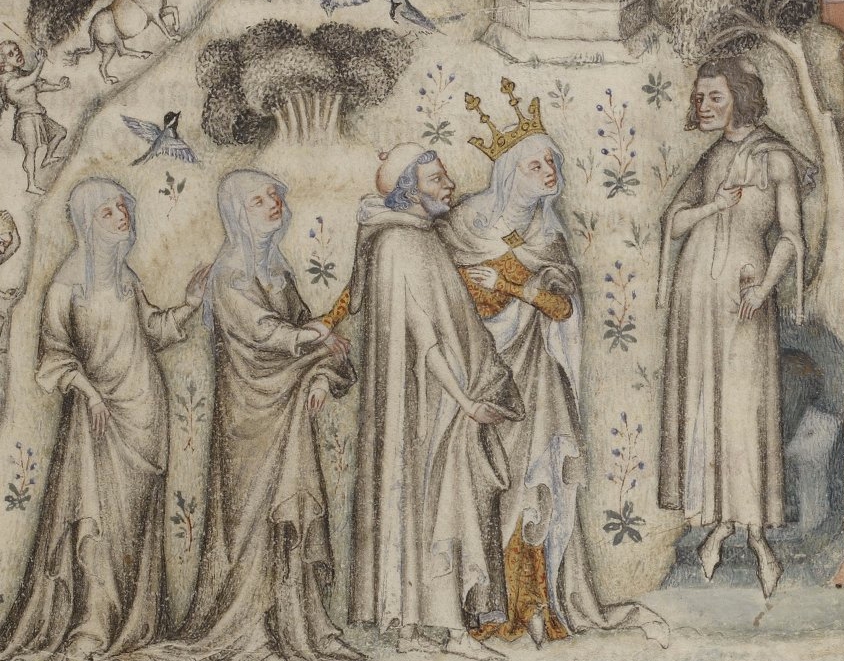
Machaut's fame rests mainly on his shorter poems and musical compositions. His technical innovations profoundly influenced his contemporaries, including Geoffrey Chaucer, whose work The Book of the Duchesse draws heavily on Machaut's poetry.
Machaut's prolific output has been preserved in 32 manuscripts that contain 23 three- and four-part motets, 19 lais, 33 virelais, 21 rondeaux, and 42 ballades. Twenty five of his 33 virelais are unaccompanied songs in the tradition of the trouvères (poet/composers of northern France), while the remaining ones are typical examples of the accompanied solo song that became popular in the 14th century.
In addition to this extraordinary number of works, Machaut was the first composer to write a polyphonic setting of the entire Ordinary of the Mass. His composition, the Messe de Notre Dame ("Mass of Our Lady"), is one of the most famous pieces of music from the 14th century. In this work, Machaut employs novel compositional techniques characteristic of the ars nova style such as syncopation and isorhythm (repeated overlapping of a rhythmic pattern in varying melodic forms).
Other Significant Figures
Anicius Boethius (c. 480-524), and later Guido d'Arezzo (c. 1000-1050), an Italian monk, were the first to write about the theoretical foundations of music. Boethius's major essay, The Fundamentals of Music, delineated the Greek theory of music. The Greeks had established music, its systems, and pitch interactions as a series of mathematical relations upon which scales are built. In the same tradition, Boethius viewed, studied, and researched music primarily as an abstract science. Guido d'Arezzo wrote the Micrologus, a work that documented musical principles essential to the later development of polyphony. The concepts of rhythmic as well as melodic independence of the voices, and the possibility of adding two or more tones to each tone in the original plainsong were, and continue to be, essential to the foundation of musical theory.
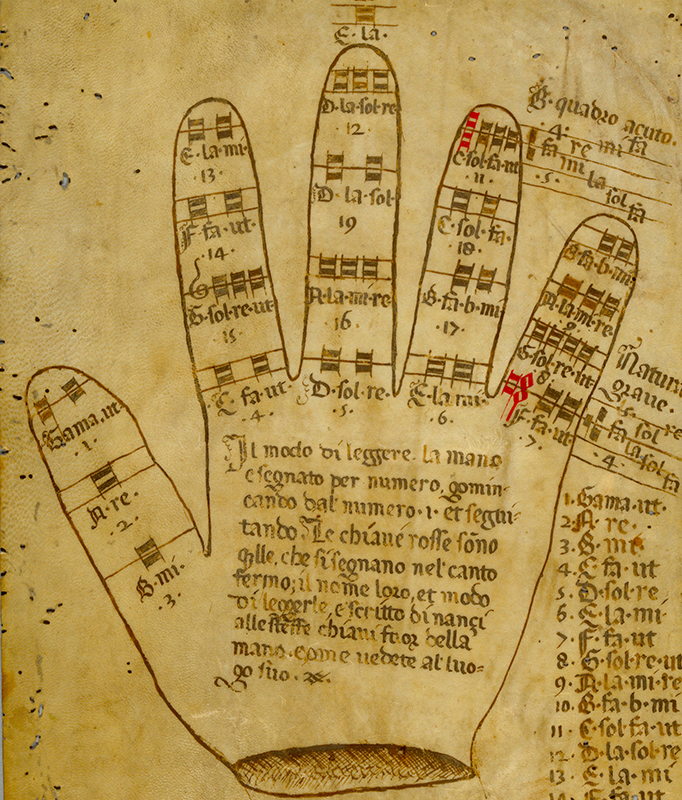
Guido d'Arezzo also invented the Guidonian hand, a system that made possible the memorization and written transmission of melodies and helped musicians locate the pitches of the musical scale. One of the most important musical theorists of the Middle Ages, d’Arezzo is further credited with adding a fifth line to the musical staff and with the invention of the system of solmization using the syllables ut, re, mi, fa, sol, la that is used up to this day. As a result of these important developments, musicians could read and perform a piece of music without having to listen to it first.