
Learning Objectives
- Outline the social, cultural, and political impact of WWI and WWII.
- Discuss the growth of the United States as a world power.
- Describe the impact of technological advancements on the development of music in the twentieth century.
- Describe, compare and contrast the main stylistic differences of Contemporary music styles including impressionism, post-Romanticism, serialism, and expressionism.
- Summarize the changing nature and application of the concept of tonality throughout the century.
- Discuss the impact of Claude Debussy's "Prelude to the Afternoon of a Faun" in light of the Symbolist movement in literature.
- Illustrate how the Russian composer Igor Stravinsky experimented with rhythm, new instrumental combinations, and the percussive use of dissonance, and discuss the impactof these techniques on contemporary music.
- Describe the impact of Arnold Schoenberg and the Second Viennese School on 20th-century music.
- Distinguish the main stylistic differences of nineteenth- and twentieth-century composers and styles.
- Describe the musical and political impact of “national schools” of composition that developed across Europe during the 20th century.
- Explain the impact of composer Aaron Copland on American contemporary music.
- Describe the impact of Latin American composers on the larger "art music" scene and repertoire.
- Define and analyze the main differences between jazz, ragtime, and blues.
Germany
On the losing end of two world wars, Germany underwent great political upheaval during the first half of the 20th century. Associated musically with Vienna since the Classical period, Germany split with its Austrian counterpart in the early decades of the new century. While Schoenberg pioneered atonal music in Vienna, founding the Second Viennese School, German composers such as Paul Hindemith (1895-1963) pursued a German style of Neoclassicism. The rise of the Nazi party after WWI prompted a great number of composers to leave, thus curtailing the development of German art music. After the dissolution of Nazi Germany, West Germany became a center of the avant-garde, led by composers such as Karlheinz Stockhausen (1928-2007) and Hans Werner Henze (b. 1926).
Paul Hindemith
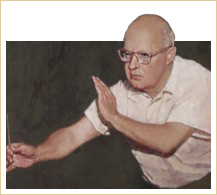
Paul Hindemith developed a thorough, if not widely imitated, compositional ideology. Although his thickly homophonic compositions were among the most complex of the century, he never fully abandoned tonality. His works, such as the Mathis der Maler Symphony (Matthias the Painter)—a series of instrumental movements taken from the longer opera of the same name—recall the expressionistic paintings of Ernst Kirchner and Wassily Kandinsky.
Composer: Paul Hindemith
-
"Symphony: Mathis der Maler (Matthias the Painter): Grablegung (Entombment)"
Karlheinz Stockhausen
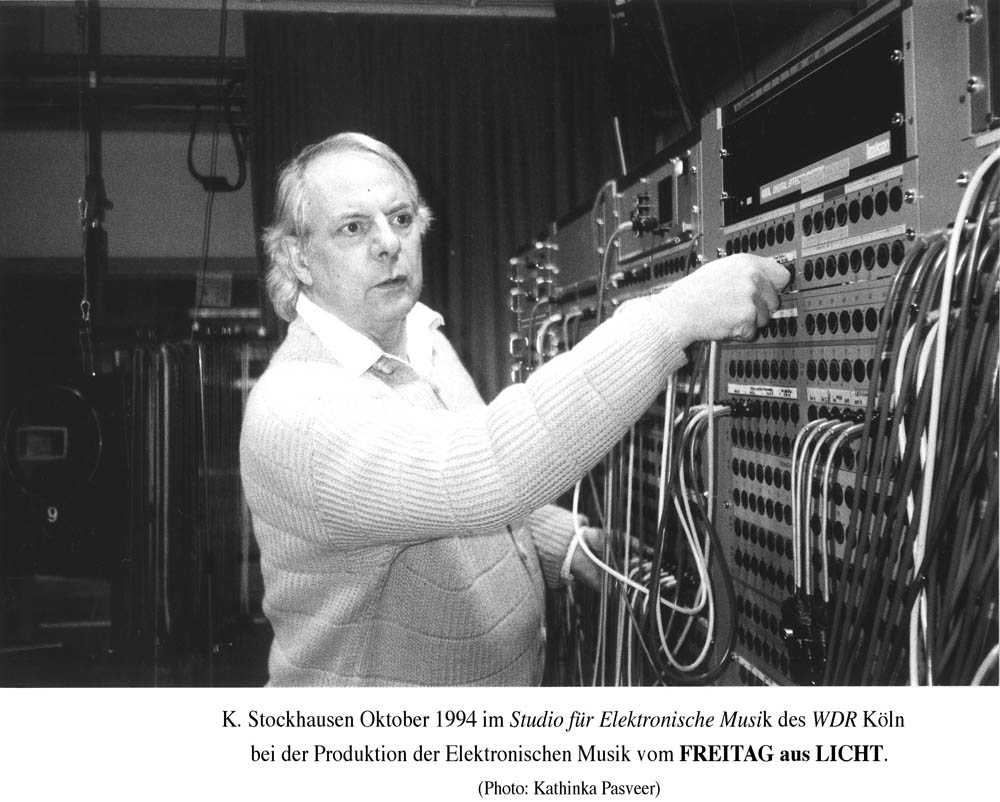
From the 1950s onwards, Stockhausen was considered among the leading avant garde figures in German music. In spite of financial difficulties, he studied in Cologne with Frank Martin (1890-1974) and was subsequently influenced by the Internationale Ferienkurse für Neue Musik, Darmstadt (Darmstadt International Summer Courses for New Music), where significant developments in new music took place. Later on, he studied in Paris with Messiaen. Alongside his work in electronic music, he explored the human element in performance, moving from total serialism, in which every aspect of a piece is controlled by a predetermined serial pattern, to a more flexible approach.
Stockhausen's works include:
- Gesang der Jünglinge for vocal and synthesized sounds on tape (1956)
- Carré for four choral-orchestral groups (1960)
- Kontakte for piano, percussion and tape (1960)
- Hymnen (1967)
- Mantra for two pianos and electronics (1970)
- Sirius (1977), a ceremonial for four costumed musicians and synthesized tape.
These works and many others have had a deep influence on a whole generation of contemporary composers, including Pierre Boulez (b. 1925) and Luciano Berio (1925-2003).
Composer: Karlheinz Stockhausen
-
"Stimmung Work No. 24: Model 4: USI-AFU (Tenor)"