Learning Objectives
- Outline the process by which woodwind instruments produce sound by setting a column of air in motion inside the body of the instrument.
- Explain the difference between the distinctive tone colors produced by woodwind instruments based on their shape, materials, and the various techniques used to play them.
The Woodwinds
Introduction
Recall from the section on timbre that aerophones produce sound via vibrating columns of air. The family of instruments known as the woodwinds may be classified as aerophones. With these instruments, sound is produced by setting a column of air in motion inside the body of the instrument. A musician may blow a stream of air into one end of the instrument either directly (as in the recorder) or indirectly (as in the flute). In some woodwind instruments, the air is used to set a reed in motion that brings about vibration of the air column (as in the clarinet and oboe).
In string instruments, the length of the string determines pitch. In wind instruments (a designation that includes both woodwind and brass instruments), the pitch is determined by the length of the air column, which the performer alters by opening or closing small holes along the side of the instrument, either with the fingers or with small pads activated by a key mechanism. Volume depends on the energy with which the player produces the air stream.
The variety of timbres among the members of the woodwind family is much greater than that among the members of the string family. Each woodwind instrument has a distinctive tone color produced by a combination of factors, the most significant of which are shape, composition (metal, wood, etc.), and the different ways in which it may be played. The mouthpiece of a woodwind instrument is the part of the instrument that is partly placed in the player's mouth. The characteristics of the mouthpiece and reed also play a significant role on the sound of the instrument.
The way the performer places the lips, teeth, and tongue on the instrument's mouthpiece is a critical factor in tone production. The technical term for the use of the lips, facial muscles, tongue, and teeth in playing a wind instrument is embouchure (ahm-buh-sher)—a French term derived from the root bouche, 'mouth'. Embouchure is so important that learning how to do it correctly is crucial to playing the instrument well, regardless of the style of music played.
The term woodwind is something of a misnomer. Although most woodwind instruments are indeed made from wood, others may be constructed from metal, ivory, or bone. For example, nowadays flutes are made of metal, while clarinets and oboes are built from ebony (wood) or ebonite (hardened rubber). Electronic instruments that combine breath and MIDI (Musical Instrument Digital Interface) technology are able to duplicate the sounds of all woodwind instruments—no air column needed. However, the term woodwind has stuck, and it remains the designation for this wonderful group of instruments.
Woodwinds refer primarily to Western orchestral instruments. There are many other woodwind-type instruments dating as far back as prehistoric times. For example, the term flute applies to a wide variety of instruments encompassing many cultures from Africa, North and South America, Asia, and Europe, as well as to similar instruments in every historical period.
The woodwind section of the traditional symphony orchestra includes the flute, the oboe, the clarinet, and the bassoon. Let's look at each one of these individually.
The Flute
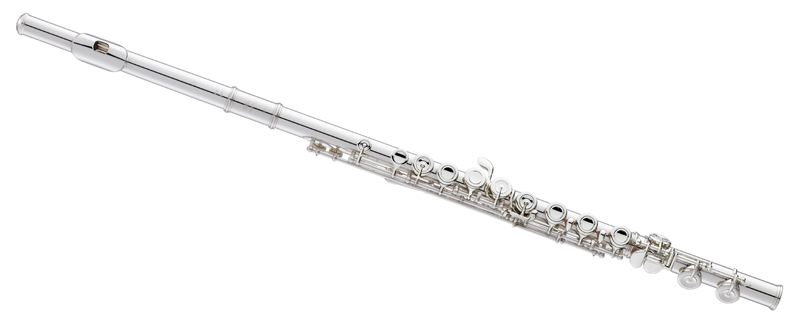

In the most general sense, the term flute may refer to any instrument for which an air column confined within a hollow body is set in motion by a stream of air released from a player's lips positioned against the sharp edge of a hole. The modern orchestral flute, patented in 1847 by the German maker Theobald Boehm, is a cylindrical tube of metal about 27 inches (66 cm) long and a bit less than an inch wide (2 cm). It has three sections:the head joint where the mouth-hole is located; the body, with most of the keys; and finally, the foot joint, which has a few keys activated by the right-hand little finger. In flute performance, most of the control of the sound comes from the player's lips.
Horizontally held flutes were present in China as early as 900 BC and first reached Europe around 1100 AD.
Visit the Dayton C. Miller Flute Collection at the Library of Congress to view a vast array of flutes. The collection contains specimens from as early as the 16th century.