Learning Objectives
- Explain how the Classical period (1750-1825) characteristics of order, objectivity, and harmonious proportion relate to the music characteristics of the period.
- Summarize how the American Revolution (1775-83) and the French Revolution (1789-99) profoundly changed political systems and social order.
- Classify the large-scale musical forms in which the Classical masters composed.
- Explain music making in the context of the royal court and the patronage system.
- Define form and absolute music, and relate these concepts to one another.
- Differentiate between the main musical forms of the Clasical-era by summarizing the development of the symphony, sonata, string quartet, and the concerto.
- Define and analyze the symphony, sonata, string quartet, and concerto forms in the context of the Classical period.
- Describe the impact of the major Classical composers Haydn, Mozart, and Beethoven.
- Discuss the impact of Beethoven's thirty-two piano sonatas.
- Compare and contrast the two types of Italian opera: opera buffa and opera seria.
Classical Period (1750-1825)
Wolfgang Amadeus Mozart
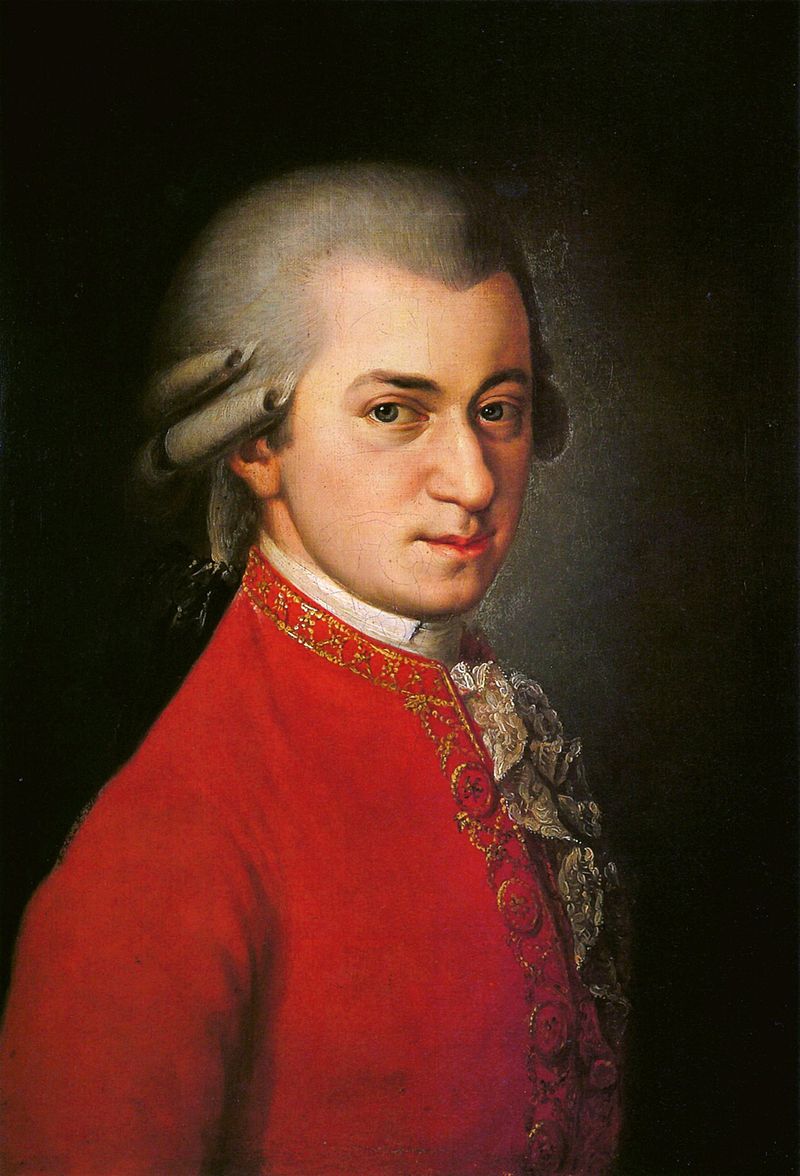
Mozart was one of the most remarkable music geniuses the world has ever known. He wrote symphonies, concertos for a variety of instruments, a great number and variety of chamber music, songs, works for piano solo, and operas. Among his instrumental compositions are symphonies including No. 25 in G minor and No. 35 in D Major, 27 piano concertos that include the famous Piano Concerto No. 21 in C major, and concertos for other instruments such as the violin, horn, and bassoon. The latter group includes the Concerto for Flute and Harp, the Horn Concerto No. 2 in E-flat major, the famous Clarinet Concerto in A major, and the less well-known Bassoon Concerto in B-flat major. Notable among his chamber works is the Clarinet Quintet in A major. His works for piano solo include 20 piano sonatas, sets of variations, for example, the Twelve Variations in C based on the French song "Ah Vous Dirai-je Maman" (known as "Twinkle, Twinkle Little Star" in English-speaking cultures), fantasias, suites, fugues, and rondos. One of Mozart's best-known works is the serenade Eine Kleine Nachtmusik (A Little Night Music). A serenade is a work written for a small orchestra, usually meant to provide light evening entertainment. Mozart's operas are some of the most often played in opera theatres worldwide.
Composer: Wolfgang Amadeus Mozart
-
"Le Nozze di Figaro K492: Crudel! Perché finora"
Composer: Wolfgang Amadeus Mozart
-
"Horn Concerto No. 2 in E flat major, K. 417: III. Rondo (Allegro)"
Composer: Wolfgang Amadeus Mozart
-
"Symphony No. 35 in D major, K385: III. Menuetto"
Composer: 0
-
"Symphony No. 25 in G minor, K183: I. Allegro con brio"
Composer: Wolfgang Amadeus Mozart
-
"Clarinet Quintet in A major, K. 581: I. Allegro"
Composer: Wolfgang Amadeus Mozart
-
"Piano Concerto No. 21 in C major, K. 467: II. Andante"
Composer: Wolfgang Amadeus Mozart
-
"Twelve Variations on the French song Ah vous dirai-je maman, K. 265"
Composer: Wolfgang Amadeus Mozart
-
"Concerto for Flute and Harp in C major, K. 299: II. Andantino"
Composer: Wolfgang Amadeus Mozart
-
"Serenade No. 13 for Strings in G Major, K. 525, Eine Kleine Nachtmusik: Menuetto: Allegretto"
Mozart's Life
The youngest child of Leopold Mozart and Anna Maria Pertl, Wolfgang Amadeus was born in Salzburg on January 27, 1756. By the age of three Mozart was already a keyboard-player and violinist. By eight he was composing symphonies. Leopold Mozart (1719-1787) undertook complete responsibility for the tutoring of Wolfgang and his elder sister Maria Anna (“Nannerl”), an extremely gifted keyboard player in her own right.
Mozart spent the years 1774 through 1777 at the Prince-Archbishop's court in Salzburg as Konzertmeister (concert master). As he matured as an artist and composer, Mozart became anxious and wished to be free from the Prince-Archbishop’s rules and the provincial atmosphere of Salzburg. It became increasingly clear that Mozart had to search for a different post. In 1777, accompanied by his mother, he set off for a tour of the major European cities in search of a worthy position. This tour included the cities of Munich, Mannheim, and Paris. In Paris and unable to speak French, Mozart's mother felt out of place and neglected while Mozart engaged in constant job hunting and socializing. In the spring of 1778, her health started to deteriorate rapidly. Shortly afterwards, Anna Maria was dead at the age of 57. She was buried in the parish of Saint-Eustache in Paris.
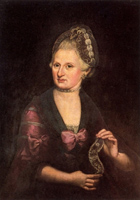
Unable to find a position that would allow him the independence and freedom to compose, Mozart returned to Salzburg by early 1779, now as court organist. Early in 1781, Mozart started entertaining ideas of becoming what today would be called a freelance artist. This was unheard of in Mozart's time, during which the patronage system was still in effect. After leaving the archbishop's appointment (with “a kick on my arse,” as he wrote), Mozart spent the last 10 years of his life in uncertain financial independence in Vienna. Although he had initial success in Vienna and Prague with German and Italian opera—Die Entführung aus dem Serail (The Abduction from the Seraglio ,1782) and Le Nozze di Figaro (The Marriage of Figaro, 1786)—and a series of paid concerts, he quickly experienced severe financial difficulties. In the summer of 1782, against his father's wishes, Mozart married Constanze Weber, whose elder sister Aloysia had rejected his love. Neither Mozart nor Constanze knew how to manage money.
The final year of his life, 1791, was one of his most productive financially and artistically. He composed The Magic Flute, La Clemenza Di Tito, a clarinet concerto, his last piano concerto, numerous pieces of chamber music, and his final choral work, the Requiem Mass in D Minor, a powerful final statement.
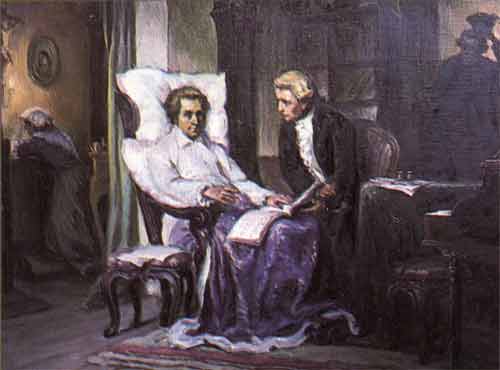
From the latter, the "Lacrimosa dies illa" is as beautiful as anything Mozart composed, even though he may not have written the entire movement himself. The mystery surrounding this work arose from the way in which it was commissioned and completed. An unknown messenger approached Mozart with a letter asking him to write a requiem setting, the traditional Latin Mass for the dead. We now know that a Count Franz Walsegg commissioned the work, probably with the intention of passing it off as his own as he was known to do. As Mozart worked on the mass, he began to feel that the music mirrored his own illness and that he was writing the music for his own death. When he died, however, he left the Requiem only half-complete, with sketches for the remainder. On his deathbed, Mozart extracted a promise from his wife that Franz Süssmayr, his favorite pupil, would be selected to finish the piece. Süssmayr completed the work making some additions of his own.