
Learning Objectives
- Relate how Romantic poets and artists abandoned traditional subjects, turning instead to the passionate and the fanciful.
- Relate how the Industrial Revolution impacted the technological development and affordability of musical instruments.
- Analyze how the orchestra grew in size and sound as new instruments were introduced and composers demanded greater levels of expression.
- Illustrate how Romantic composers explored nationalistic folklore and exotic subjects.
- Identify the form of romantic period songs, including strophic, through-composed, and the modified strophic forms.
- Examine the German art song (or Lied) as a favored romantic period genre.
- Discuss how the music of Franz Schubert impacted romantic period music.
- Discuss how the music of Frédéric Chopin impacted romantic period music.
- Trace the ascendance of program music in relation to absolute music.
- Summarize how political unrest throughout Europe stimulated the formation of schools of musical nationalism in Russia, Scandinavia, Spain, England, and Bohemia among other countries.
- Differentiate between the distinct national styles of romantic opera in France, Germany, and Italy.
- Discuss how the Italian nationalist composer Giuseppe Verdi impacted romantic period music.
- Trace how choral music became a popular artistic outlet for the middle classes.
- Discuss how the Russian composer Pyotr Ilyich Tchaikovsky impacted romantic period music.
Romantic Period (1820–1910)
Italian Opera
Giuseppe Verdi
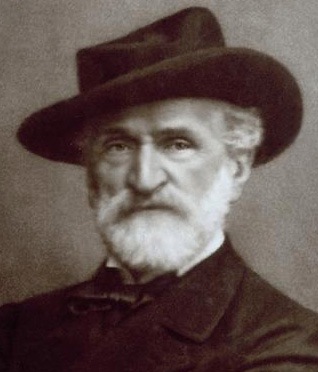
Widely acknowledged as the greatest Italian opera composer and one of the most influential musicians of the 19th century, Giuseppe Verdi devoted his life to refining and expanding traditional Italian opera; his music embodied the grandest and most elaborate Romantic gestures. After growing up in relative poverty in northern Italy, Verdi studied in Milan, then returned home and married at the age of 23. His first opera, Oberto, was successfully produced at Milan's famous La Scala Theater in 1839. At the urging of the theater director, he composed Nabucco, the story of the Babylonian king Nebuchadnezzar. At the time, Italy was struggling to free itself from Austrian rule; the story of the Jews' struggle for freedom from Babylon and their desire to return to their homeland struck a nerve with the Italian public. The chorus "Va, pensiero, sull'ali dorate" (Fly, thought, on wings of gold) became a de facto national anthem, and the opera turned Verdi into a national hero.
Composer: Giuseppe Verdi
-
"Nabucco: Nabucco, Act III: Va, pensiero, "
Despite occasional retirements, most notably between 1871 and 1887, Verdi’s artistic success continued until his death at age 87. Although his style at times had characteristics in common with Grand Opera—a Romantic genre that contained no spoken dialogue and employed huge choruses, serious plots, elaborate dance episodes, ornate costumes, and spectacular scenery—he more often retained the traditional Italian forms of opera seria and opera buffa.
Verdi worked within the typical Italian forms of chorus, aria, recitative, and ensemble even in his late operas, but he skillfully grouped such numbers into larger dramatic units that moved the action forward. His famous aria “La donna è mobile” (Woman is fickle), from Rigoletto (1851), reveals his gift for extremely catchy melody. Rigoletto, based on a play by Victor Hugo, takes the rather daring subject of a hunchbacked court jester who plots to kill the Don Juan-type duke who has seduced his daughter. In this scene, the Duke first sings his memorable song about how women are fickle anyway, so presumably his actions are justified. Next, Rigoletto and his daughter Gilda watch through a crack as the philandering Duke attempts to seduce yet another woman (named Maddalena). The quartet that follows the Duke's aria gives each character an emotion or quality: Rigoletto is angry, his daughter is heartbroken, Maddalena is coquettish, and the duke is suave.
Composer: Giuseppe Verdi
-
"Rigoletto: La donna e mobile"
Qual piuma al vento,
Muta d'accento—e di pensiero.
Like a feather in the wind,
She changes her voice—and her mind.
Leggiadro viso,
In pianto o in riso—è menzognero.
Pretty face,
In tears or in laughter—she is always lying.
Chi a lei s'affida,
Chi le confida—mal cauto il cuore!
Is he who trusts her,
He who confides in her—his unwary heart!
Felice appieno
Chi su quel seno—non liba amore!
Fully happy
Who on that bosom—does not drink love!
Verdi’s operas continue to be performed regularly in opera houses all over the world today. The most popular include Il trovatore (The Troubadour; 1853), La traviata (The Fallen Woman; 1853), Un ballo in maschera (A Masked Ball; 1859), La forza del destino (The Force of Destiny; 1862), Aida (1871), Otello (1887), and Falstaff (1893). The latter is his only comedy, aside from a very early one that was not successful. Otello and Falstaff are both Shakespearean subjects.
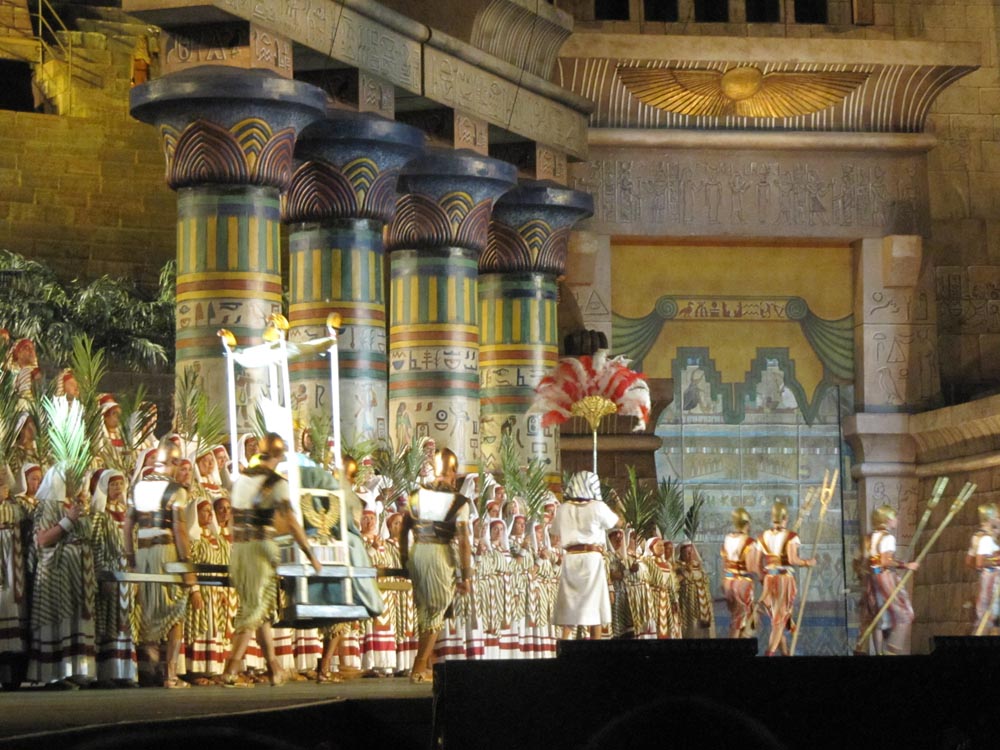
Verdi’s epic opera Aida was commissioned for the opening of the new opera house in Cairo and first performed there in 1871. The Suez Canal had opened two years earlier and apparently Verdi had been asked to write an opera for that occasion, but he declined. At any rate, Egypt was on Europeans’ minds due to the recent construction of the Suez Canal, an enormous engineering feat that had opened a water route from the Mediterranean to India and the Far East. Verdi’s opera also called for rather enormous engineering feats, in terms of staging. “Epic” seems an appropriate word for an opera that features live elephants! (Some recent performances have still used them.) The subject was a tragic love triangle among Egyptian and Ethiopian royalty. Follow the Listening Guide for insight into the music of the Triumphal March and Chorus from Act II. The Egyptian people are singing their praise to Egypt, to Isis (protector of the country), and to their king.
Composer: Giuseppe Verdi
-
"Aida: Act II: Triumphal March"
This kind of masterful choral writing is also on full display in Verdi’s beloved Requiem, completed in 1874 and written to commemorate the death of the great Italian poet Alessandro Manzoni (1785–1873).
Verismo
A new style of opera known as verismo (realism) appeared in in Italy in the last decade of the 19th century. Influenced by the slightly earlier Italian literary verismo and the naturalism of important writers such as Emile Zola in France and Henrik Ibsen in Norway, verismo in opera used passionate declamation and emotionally charged harmonies and melodies to depict everyday people—commonly of lower social classes—in ordinary, realistic, violent, melodramatic, and sometimes even sordid situations. The main exponents of operatic verismo were Pietro Mascagni (1863–1945), Ruggiero Leoncavallo (1858–1919), and Giacomo Puccini—the most important Italian opera composer after Verdi.
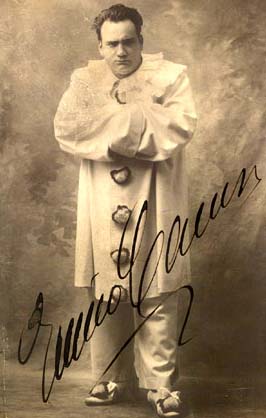
Mascagni’s masterpiece of verismo is Cavalleria rusticana (Rustic Chivalry; 1890), while Leoncavallo is best known for I Pagliacci (Clowns; 1892). The two works are frequently performed in opera houses together. The latter is the story of Canio, a circus clown whose unrequited love for the beautiful Columbina eventually leads him to murder his romantic rival. (These names are taken from the medieval commedia dell’arte, which featured stock characters representing certain “types.”) In the famous recitative and aria, “Vesti la giubba” (Put on the costume), Canio decries the fact that he must now wear “a clown’s fake smile” while inside, he is in agony. This new awareness of the subconscious workings of the inner mind was also manifest in the work of such psychoanalysts as Sigmund Freud.
Composer: Frederick Edward Weatherly
-
"Pagliacci: Vesti la giubba"
Giacomo Puccini
The greatest (and most eclectic) of the Italian late Romantic composers was Puccini. His operas retain wide appeal, and his arias are some of the most familiar in the operatic repertoire.
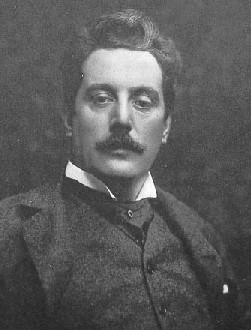
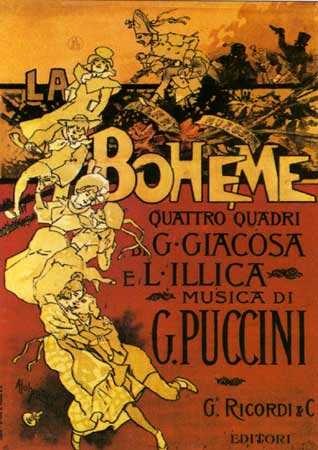
Born into a family with five generations of musical tradition, Puccini showed surprisingly little interest in music as a child. The turning point came in 1876, when he saw a production of Verdi's Aida in Pisa and decided to follow in the older composer's footsteps. He studied at the Milan Conservatory from 1880 to 1883 and produced his first opera, Le villi (The Fairies), in 1884. Its success led to publication by the big Ricordi publishing house, which would remain his publisher for the rest of his career. Few opera houses had a season that didn't feature at least one of Puccini's subsequent operas. These included Manon Lescaut (1893), the only opera without a credited librettist; La bohÉme (1896), whose premiere was conducted by the young Arturo Toscanini; Tosca (1900), Puccini's first work using the verismo approach pioneered by Leoncavallo's I Pagliacci; and Madama Butterfly (1904), in which he used authentic Japanese folk tunes. Puccini composed three one-act operas late in life: Il tabarro (The Cloak), Sour Angelica (Sister Angelica), and the comedy Gianni Schicchi, featuring “O mio babbino caro” (Oh my dear papa), one of Puccini's most popular arias of all time. A final opera, Turandot, was left unfinished.
Puccini was a skillful composer with a genius for melody and a flair for drama. In the aria “O mio babbino caro” from Gianni Schicchi, the soprano sounds as though she is singing about the heavens unfolding. In reality, she is singing to her father, threatening to throw herself off a bridge in an impetuous fit if he does not let her marry.
Composer: Giacomo Puccini
-
"Gianni Schicchi: Gianni Schicchi: O mio babbino caro"
mi piace, è bello, bello.
Vo'andare in Porta Rossa
a comperar l'anello!
I love him, he is handsome, handsome.
I want to go to Porta Rossa
To buy the ring!
e se l'amassi indarno,
andrei sul Ponte Vecchio,
ma per buttarmi in Arno!
And if my love were in vain,
I would go to the Ponte Vecchio
And throw myself in the Arno!
O Dio, vorrei morir!
Babbo, pietà pietà
Babbo, pietà pietà
Oh God, I'd like to die!
Papa, have pity, have pity!
Papa, have pity, have pity!
“Vissi d’arte” (I lived for art), from Tosca, may be the composer’s greatest moment in verismo opera.
Composer: Giacomo Puccini
-
"Tosca: Act II: Vissi D'arte"
non feci mai male ad anima viva!
I never did harm to a living soul!
quante miserie conobbi aiutai.
I relieved as many misfortunes as I knew of.
la mia preghiera
ai santi tabernacoli salì.
My prayer
Rose to the holy shrines.
diedi fiori agli altar.
I gave flowers to the altar.
perchè, perchè, Signore,
perchè me ne rimuneri così?
Why, why, Lord,
Why do you reward me thus?
e diedi il canto agli astri, al ciel,
che ne ridean piùbelli.
And songs for the stars, in heaven,
That shone forth with greater radiance.
perchè, perchè, Signore,
ah, perchè me ne rimuneri così?
Why, why, Lord,
Ah, why do you reward me thus?