
Overview
In the 1910s and 1920s, new types of musical theater were emerging on the American stage. Vaudeville, which had been the main type of musical and theatrical entertainment since the late 1800s, remained popular. Revues such as the Ziegfeld Follies included a series of popular tunes, skits, and dance numbers. The book musical was a play that included several songs performed by the characters. Composers such as Irving Berlin, Jerome Kern, and George and Ira Gershwin wrote hundreds of songs for these musical theater productions. Although most of the American musicals that were written during this era have been forgotten, their songs survive in what are known as standards.
Objectives
- Examine the transitional period between Tin Pan Alley songs and the rise of the Broadway musical
- Identify a number of important early composers and lyricists of Broadway songs such as George and Ira Gershwin, Irving Berlin, and Cole Porter
- Examine how and why many of the songs from these musicals survived long after musicals themselves flopped or were canceled
The Composers of Broadway
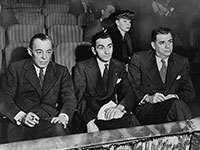
Israel Baline was one of the first Broadway composers. He dropped out of grade school to work as a busker (street entertainer), singing sentimental ballads in saloons and on street corners. He was especially gifted at writing parodies, that is, clever new lyrics for existing folk and pop tunes. Baline was sweeping floors and singing those parodies in Pelham’s Cafe in Chinatown. When Pelham’s pianist asked Baline for lyrics for a tune he had written, he wrote several verses. "Marie from Sunny Italy♫" made thirty-seven cents each for its creators while the publisher, Joseph W. Stern and Co., made several hundred dollars. The lyricist was not compensated. That lesson was not lost on the young lyricist, who was now calling himself Irving Berlin.
By his late teens, Berlin had made a name for himself in the music business as a staff lyricist for the Tin Pan Alley music publisher Ted Snyder. He purchased a piano and began to create melodies to go with the lyrics he was writing. Berlin had limited skills in reading music and writing harmony, so he often would write a single-line melody by himself and then bring in another musician to transcribe his melody into proper music notation. By age 22, Berlin had placed songs in four different revues, including the Ziegfeld Follies. Keenly aware of the financial realities of the music business, Berlin established his own publishing firm in order to ensure that he received royalties for his compositions. By age 24, he was already a millionaire, thanks to the popularity of catchy songs such "White Christmas ♫" and "There's No Business Like Show Business ♫."
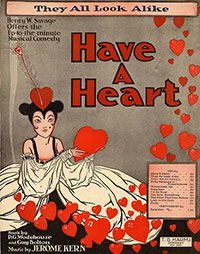
Equally talented as Irving Berlin was Jerome Kern. His parents sent him to Germany after high school to study harmony and music theory, which was typical for young men at the time who wanted to become composers. On his way back to the United States, he spent a year in London as a rehearsal pianist in vaudeville and operetta productions. He quickly earned a reputation as a skillful pianist and tune doctor, one who could "cure" a weak tune by changing a few notes or chords. When he finally returned to the United States, Kern became a fixture in American musical theater. Between 1905 and 1912, he wrote over 100 songs for 31 musicals including "Yesterdays ♫," and "The Last Time I Saw Paris ♫." Kern’s masterpiece is Show Boat (1927), with lyricist Oscar Hammerstein II. Show Boat included many memorable songs, including "Can't Help Lovin' Dat Man of Mine ♫" and "Ol' Man River ♫." Show Boat was one of the first successful book musicals, and it provided the model for many other musicals that would be written in the following decades.
At age fifteen, George Gershwin dropped out of high school to work as a demonstration pianist in the publishing houses of Tin Pan Alley, and soon, his original tunes were being sung in revues. In 1919, at age twenty-one, Gershwin had his first major hit, a tune called "Swanee ♫." When vaudeville performer Al Jolson inserted it into his show at the time, the tune became an instant smash. Gershwin composed hundreds of songs that appeared in revues, vaudeville shows, and book musicals. For the most part, his songs were written in collaboration with his brother and lyricist, Ira.
George and Ira Gershwin’s "I Got Rhythm ♫" has a form that was typical of Broadway songs of this period. "I Got Rhythm ♫" is in 32-bar AABA song form. Many Broadway songs continued to use this formula throughout the twentieth and into the twenty-first centuries.
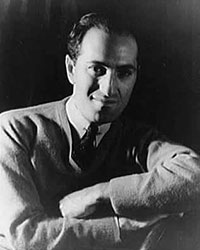
32-bar song form is 32 measures (bars) long, and it follows this pattern for the melody, where each letter is eight measures long:
A
A
B
A
The B section often offered a contrasting harmony or sentiment to the A section.
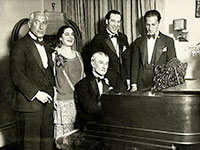
Broadway composers followed this 32-bar form over and over again, which appealed to audiences in its predictability but kept them interested because composers and lyricists created interest and contrast within this specific form. "I Got Rhythm ♫" is not only a staple of the Broadway song repertory, but, as we will see, it became an important part of early jazz.
Composer Richard Rodgers and lyricist Lorenz Hart began collaborating when they were still in high school. After a few years at Columbia University, Rodgers and Hart moved into the professional world and wrote hundreds of songs together.
Seven of their early songs appeared in a show called The Poor Little Ritz Girl in 1920. Then, Rodgers and Hart wrote the songs for several musicals that failed commercially but produced a few classic songs, such as "With A Song In My Heart ♫" In the late 1930s, the two finally began producing book musicals that received acclaim, such as Babes in Arms (1937) and Pal Joey (1940). Over their 25-year partnership, Rodgers and Hart wrote nearly a thousand songs, some of the most famous of which are "My Funny Valentine ♫," and "Where or When ♫."
When Hart’s health began to fail, Rodgers teamed up with Oscar Hammerstein II for the second half of his career. Rodgers and Hammerstein became an industry in the world of the book musical, and they set a new high level of lyric theater musicals such as Oklahoma (1943), The King and I (1951), and The Sound of Music (1959). Among their iconic songs are "People Will Say We're In Love ♫," "Some Enchanted Evening ♫," and "Climb Every Mountain ♫." Rodgers and Hammerstein created some of the most successful musicals both of their time and of all time. Even in the twenty-first century, the songs and musicals of Rodgers and Hammerstein are standard repertory for any Broadway performer—aspiring, amateur, or professional.
Like Irving Berlin, Cole Porter wrote his own words and music, and also like Berlin, he is remembered more for individual songs than for complete shows.
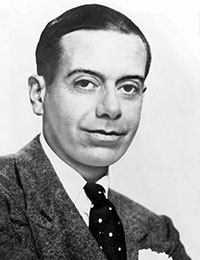
Porter’s lyrics contain more intellectual references to poetry, philosophy, history, painting, and literature than do the lyrics of any other Broadway songwriter. He is best known for the 1934 classic "Anything Goes ♫" and "I Get A Kick Out of You ♫" and for the 1938 Kiss Me, Kate with "Too Darn Hot ♫" and "Wunderbar ♫." Porter was especially fond of innuendos and evocative lyrics in his songs, such as in "I've Got You Under My Skin ♫" and "Let's Do It (Let's Fall in Love) ♫."



