
Overview
First called “hillbilly music” by record labels, early country and western music was recorded in southern areas of the United States by ambitious record producers who were looking for a new, commercially-appealing sound. With the advent of radio, this type of music became incredibly popular, spawning a number of subgenres, such as bluegrass, honky-tonk, and country crooning. The film popularity of singers such as Gene Autry also cemented the image of the singing cowboy in the minds of many Americans. As we will see, early country and western music had many themes and images that continue to permeate country music to this day.
Objectives
- Examine how country music was first discovered by record executives such as Ralph Peer and what made it so commercially appealing
- Identify early recording artists who increased the commercial appeal of hillbilly music
- Recognize the several subgenres of country music developed during and after World War II
- Identify instruments played in a bluegrass ensemble
- Recall the BMI and the ASCAP strike in the early 1940s and how it helped the development and distribution of early country music
The Rise of Country and Western Music (continued)
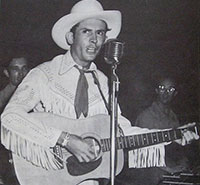
The biggest honky-tonk star of the era, however, was Hank Williams. Williams captured the hearts and minds of hundreds of thousands of country music fans in his brief career. He grew up the son of an Alabama sharecropper, raised in poverty. He listened to the recordings of Roy Acuff and Ernest Tubb, but he was also deeply affected by African American musical traditions. Although the amount of his influence cannot be established, a black singer named Rufus Payne mentored Williams for a while, teaching him songs and guitar techniques. Williams was also affected by the religious music that he heard in the fundamentalist Baptist churches he attended as a child.
Williams began his career on Louisiana Hayride, a radio program that aired on KWKH, a station in Shreveport, Louisiana. Only four months after he joined Louisiana Hayride, he was recruited to appear on the Grand Ole Opry. The Grand Ole Opry chose Williams based largely on the success of his recording of "Lovesick Blues ♫" (1949). "Lovesick Blues ♫," written in 1922 by Tin Pan Alley songwriters Irving Mills and Cliff Friend, had been recorded by several other country artists, but Williams’s rendition is considered the definitive version of the song.
Williams saw his music as an extension of his own thoughts and feelings. As he once explained, "When a hillbilly sings a crazy song, he feels crazy. When he sings ’I Laid My Mother Away,’ he sees her laying right there in the coffin." Many of his songs from the early 1950s speak of tragedy and longing, such as "Cold, Cold Heart ♫" and "Your Cheatin' Heart ♫." Although these songs were not necessarily autobiographical statements, they did speak to a sense of struggle and heartbreak that Williams felt in his own life. To Williams, hillbilly musicians were "more sincere than most entertainers because the hillbilly was raised rougher than most musicians. You got to know a lot about hard work."
Williams’s short life was marked with difficulty. He was fired from the Grand Ole Opry in 1952 because of his constant drunkenness, which led him to return to the Louisiana Hayride. A painful congenital spinal condition left him with a stooped posture and an addiction to prescription painkillers. When he was sober, he gave remarkable live performances, but more often than not, he was too drunk to perform. Williams died just shy of his thirtieth birthday of a heart attack, brought on by a lifetime of substance abuse. Despite his incredibly short career, Williams was and remains one of the most influential figures in the history of country music.



