
Overview
As we saw in earlier lessons, solo singers became increasingly important during the 1930s. Singers such as Ella Fitzgerald and Bing Crosby built long, successful careers with their interpretations of jazz and Broadway standards. More and more singers followed in this mold in the 1940s and early 1950s, including Frank Sinatra, Perry Como, Patti Page, and Doris Day. Singing groups were common as well, such as the Ink Spots and the Boswell Sisters. Although many singers began in the Broadway or big band mold, many branched out into covers of all types of tunes from a variety of genres.
Objectives
- Examine a number of popular singers and singing groups from the 1940s and 1950s
- Examine how each singer or group offered a unique perspective for the interpretation of standard tunes
- Recognize the different interpretations of the same standard
- Examine how each artist was able to create an identity while performing much of the same repertory
Tony Bennett
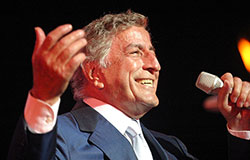
Anthony Dominick Bennedetto, born in Queens, got his first break at age twenty-four on the Arthur Godfrey Talent Scouts Show under the name Joe Bari. At the time, he was working as an elevator operator and singing free for anyone who would listen. Bob Hope heard him in a guest appearance on Pearl Bailey’s show at a Greenwich Village nightclub, suggested a name change, and took him on a national tour. When the tour ended, Mitch Miller at Columbia Records took interest, and selected "The Boulevard of Broken Dreams ♫" as a trial record.
Then came "Because of You ♫," "Cold, Cold Heart ♫," and later, his 1962 blockbuster, "I Left My Heart in San Francisco ♫," which became Bennett’s signature song. As of 2017, Bennett is still actively recording music and collaborating with artists as eclectic as k.d. lang, Christina Aguilera, and Billy Joel.



