
Overview
In an earlier lesson, we encountered a number of subgenres of country and western music that became popular during the 1940s, such as the country crooner and honky-tonk. In this lesson, we will focus specifically on the genre of bluegrass. Bluegrass music had had devoted followers since its earliest days, but during the 1960s, more and more people came to listen to and appreciate the music. The folk revival movement, coupled with mainstream exposure in Hollywood films, introduced a new generation of listeners to bluegrass.
Objectives
- Identify three key figures of bluegrass: Bill Monroe, Earl Scruggs, and Lester Flatt
- Examine the three musicians and the key characteristics of bluegrass music, such as instrumental techniques, instrumental combinations, and the connections between bluegrass music and earlier types of hillbilly music such as the string band
Bluegrass Takes Off
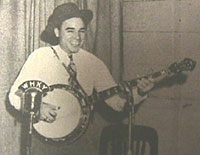
In 1948, within weeks of each other, Flatt and Scruggs resigned from Bill Monroe's Blue Grass Boys to escape the constant traveling. They teamed up to do a few radio shows, and then they formed a permanent arrangement. They recruited Jim Shumate on fiddle, Cedric Rainwater on bass, and Mac Wiseman on guitar, and they called themselves the Foggy Mountain Boys. "Foggy Mountain Boys" is a song that was recorded by the Carter Family during the 1920s.The musicians in the band greatly admired the Carter family, especially Maybelle Carter's distinctive guitar playing style.
Between 1948 and 1950, the Foggy Mountain Boys recorded a number of songs for Mercury that are still regarded as some of the most exciting and important bluegrass numbers in the history of the genre. Songs such as "My Little Girl in Tennessee ♫," "Foggy Mountain Breakdown ♫," and "Old Salty Dog Blues ♫" are copied and covered by bluegrass musicians to this day. In the 1950s, the group toured widely. They played in venues that were considered traditional outlets for country music, such as store openings, schools, and county fairs, but as they became more popular, they began to sell out major auditoriums and perform at music festivals, clubs, and even Carnegie Hall. In 1953, the Martha White Flour Mills company hired the Foggy Mountain Boys to perform for fifteen minutes every morning on Nashville's WSM. This exposure led to WSM adding the Foggy Mountain Boys to the regular cast of the Grand Ole Opry in 1955.

"Foggy Mountain Breakdown ♫," recorded in 1949, was one of the first singles released by the Foggy Mountain Boys. The song has become a bluegrass standard. Composed by Earl Scruggs, "Foggy Mountain Breakdown ♫" features Scruggs on a Gibson Granada five-string banjo. In bluegrass, a breakdownan instrumental section of a bluegrass song, usually one in which a banjo, fiddle, or mandolin solo is featured< refers to an instrumental section of a song, usually one in which a banjo, fiddle, or mandolin solo is featured. In bluegrass, it was common to name a purely instrumental track a "breakdown" to signal that it contained no lyrics; examples include Bill Monroe's "Blue Grass Breakdown ♫" and Scruggs's own "Earl's Breakdown ♫." As we will see, "Foggy Mountain Breakdown ♫" was not only popular when it was released, but it also experienced a resurgence in interest when it appeared in the soundtrack for a film during the 1960s.
The remarkable musicianship of both Flatt and Scruggs made the Foggy Mountain Boys extremely popular both live and in their recordings. Scruggs's virtuosic three-finger style meant that he could play solos at breakneck speeds; his performances were notable because he frequently stood still and poker-faced while he played, belying the difficulty of his performances. During the 1950s, he began experimenting with another technique on the banjo, in which he adjusted the banjo's tuning pegs to slide audibly from one chord into another. In "Earl's Breakdown ♫," these swoops from one chord to another can be heard, and Scruggs achieved this simply by turning the tuning pegs. By 1952, he had invented a device that allowed him to retune the instrument quickly. Flatt was also a remarkable musician. During his time with Bill Monroe's band, he developed a technique that allowed him to catch up with the other musicians. This technique, now called a Lester Flatt G runa guitar technique developed by Lester Flatt that consisted of an ascending run that allowed Flatt to reunite with the other musicians on the beat; it is one of the most widely imitated instrumental gestures in bluegrass music, was an ascending run that allowed Flatt to reunite with the other musicians on the beat. Originally developed as a way to catch up with the other musicians in case he fell behind, the Lester Flat G run is now one of the most widely imitated instrumental gestures in bluegrass music.



