Overview:
Most music is created with a key or pitch center; a group of pitches based on a scale in which each pitch has a corresponding chord that in turn, have a unique relationship within the grouping. A key signature contains accidentals (sharps and flats) as a short-hand method of indicating which pitches require the accidentals so that they don’t need to be written throughout the entire composition. The pitch center or scale gives a music composition a sense of stability and cohesiveness through melodic and harmonic progressions of tension and release.
Objectives:
Students will be able to:
- Identify the basic major scale patterns.
- Identify how the scales relate to the key of a music composition.
- Define the meaning of transposition, key, and scale.
- Identify the purpose of meter in musical composition.
- Define how changes in note beams and ties alter duration within the phrase.
- Define the musical term anacrusis.
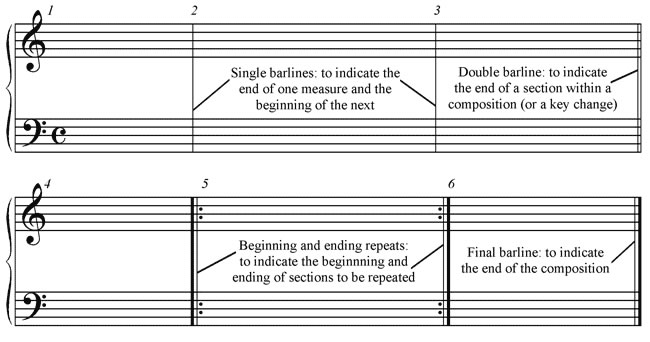
Types of Barlines
Barlines serve two main purposes: They indicate where the strong beats fall and help organize the music into clearly visible divisions called measures or bars. The main beat in every measure happens right after the barline.
In the example below, each measure contains two beats—a strong and a weak one—separated by a bar line. Numbers above the barlines identify the measures. Although used as a synonym of measure, the term bar refers strictly to the vertical lines that separate measures rather than to the measures themselves.
Different types of barlines help identify measures, sections, repeat sections, and the end of a composition.