
Overview:
Although music is abstract in nature, its concepts can be made concrete for young students. This class will focus on ways in which elementary students can gain skills and understanding of the elements of music by taking part in guided experiences.
Objectives:
Students will be able to:
- Identify the ways in which the elements of music can be introduced to younger students.
- Identify the age- and grade-appropriate music activities.
- Discover ways in which elementary students can respond (verbally and non-verbally) to music.
- Guide elementary students to move from percepts to concepts.
- Identify issues common to teaching music.
Three-part (ABA)
One of the most common patterns of musical form is the three-part or ternary form, often referred to as ABA form or as song form. This structure is the presentation of a musical idea followed by a contrasting idea, and then the repetition of the first idea.
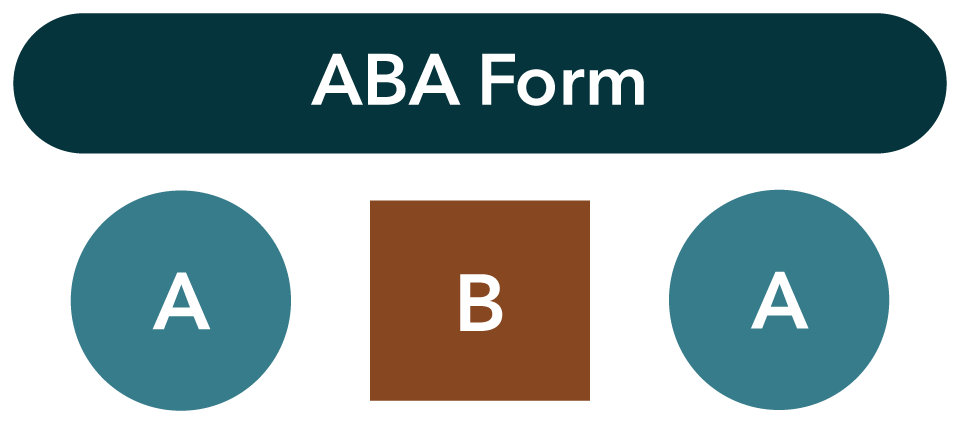
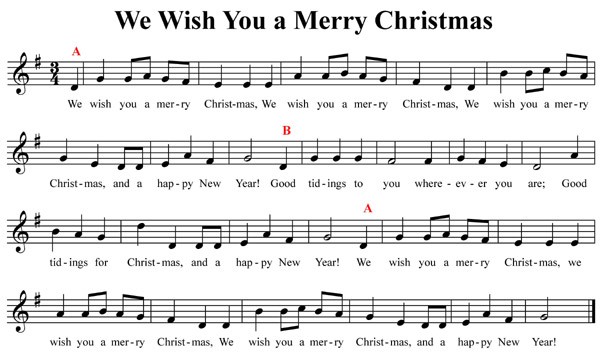
The repetition provides unity, with the middle section providing contrast or variety. “We Wish You a Merry Christmas” is an example of ABA form.
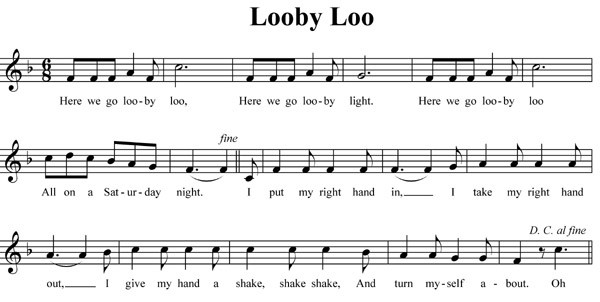
Songs in ABA form are often not completely written out but use the D.C. al Fine (Da Capo al Fine) marking instead. This marking directs the performer to return to the beginning and continue to Fine, or “end.” The song, “Looby Loo,” is an example of ABA form with the D.C. al Fine marking.
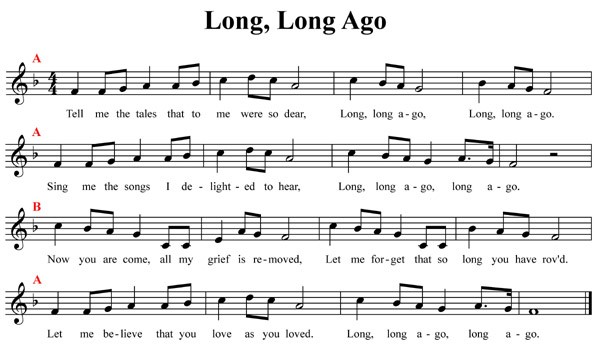
A common variation of ABA form occurs when the section repeats immediately. Then the pattern becomes AABA. The song “Long, Long Ago,” shown here, follows this pattern. The AABA form is also the standard pattern for commercial and pop music.
The organizational principle of statement-contrast-return is found in medieval chants, simple folk songs, contemporary pop music, and elaborate movements of symphonies. The phrases do not always strictly follow the ABA or AABA pattern but are varied depending upon the composer’s ideas. The phrases are not always three or four in number. Most musical compositions, however, have some repeated phrases or sections and one or more contrasting sections.
The understanding of song forms, however, is an ideal starting point for the analysis of longer compositions that have many sections.