
Overview:
Although music is abstract in nature, its concepts can be made concrete for young students. This class will focus on ways in which elementary students can gain skills and understanding of the elements of music by taking part in guided experiences.
Objectives:
Students will be able to:
- Identify the ways in which the elements of music can be introduced to younger students.
- Identify the age- and grade-appropriate music activities.
- Discover ways in which elementary students can respond (verbally and non-verbally) to music.
- Guide elementary students to move from percepts to concepts.
- Identify issues common to teaching music.
Strophic
Songs with repeated music but different words are “strophic” songs. An example of a strophic song is the one-part song “This Old Man.”
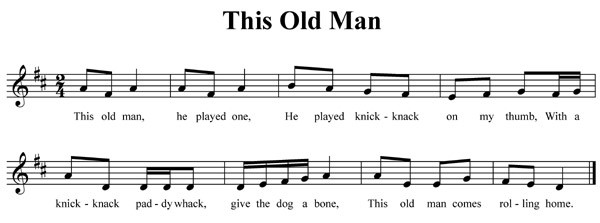
- This old man, he played two,
He played knick-knack on my shoe.
With a knick-knack…. - This old man, he played three,
He played knick-knack on my knee.
With a knick-knack…… - This old man, he played four,
He played knick-knack on the floor.
With a knick-knack……
More verses follow, going through the numbers consecutively.
Rondo
An extension of the ternary or ABA form is rondo form. Rondo form is based on repetition and consists of a statement, followed by a contrasting section, then a return of the statement followed by a different contrasting section, and ending with the return of the first statement.
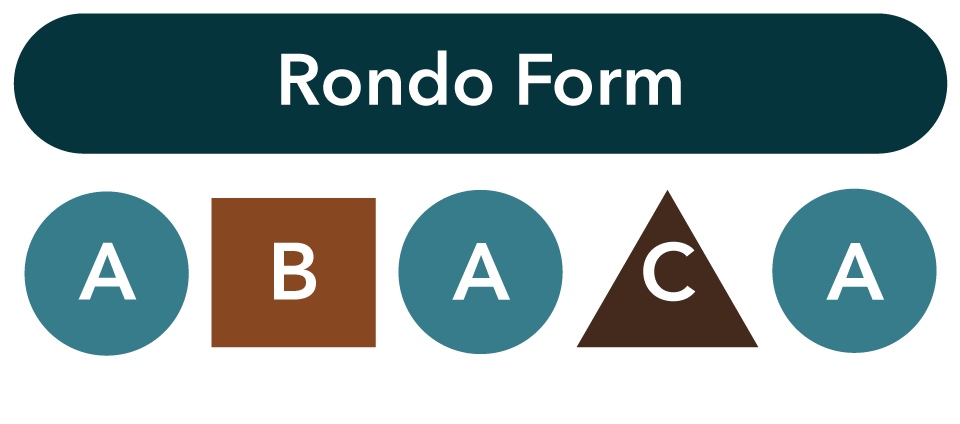
Elementary students most easily understand five-part rondos (ABACA), although they may find seven-part rondos (ABACADA) interesting. When the A theme returns, it is often altered slightly. If that is the case, the A becomes A1. The Rondo in G by Reinhold Glière is an example of a five-part rondo. Examples of longer rondo forms can be found in these works by Mozart: the finale of Sonata in C Major, K. 545 and the "Turkish" rondo in the Sonata in A Major, K. 331.