
Overview
The history of jazz rightly begins in the city of New Orleans. In this section, we will learn about great New Orleans jazz musicians and their early recordings in Chicago. In the process, will also learn about the emerging Chicago jazz scene and some of the artists from that area who helped develop early jazz musical styles. Finally, we will do a short overview of early jazz in New York.
Objectives
Upon completion of this lesson, you will be able to do the following:
- Define collective improvisation
- Identify early jazz musicians and their contribution to jazz music
- Appreciate the significance of Dixieland jazz
- Recognize the impact Chicago had for musicians of early jazz
- Recognize the growing importance of New York for further developments in jazz
- Define chord substitutions
Louis Armstrong
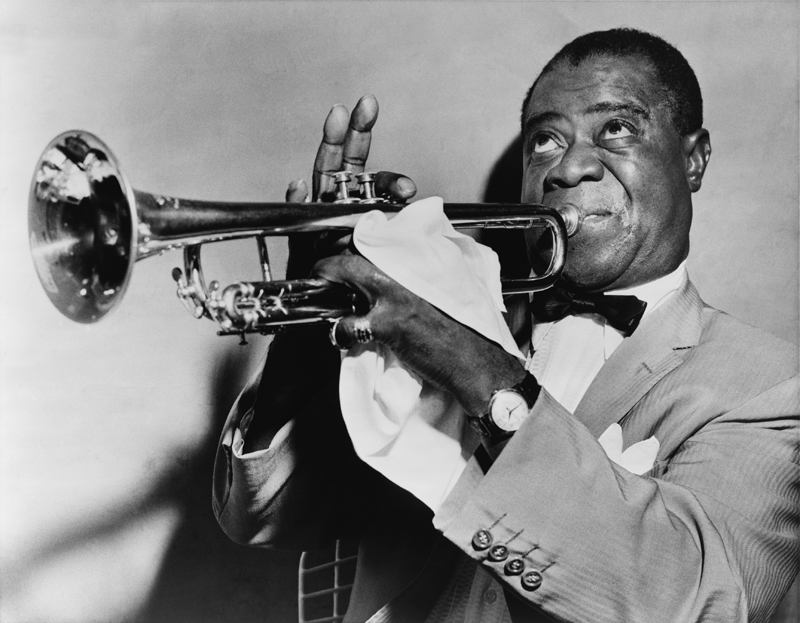
The evolution of jazz — from an art of collective improvisation to an art in which the improvising soloist reigns supreme — might have been inevitable. But the history of that evolution would not be what it is without Louis Armstrong (1901-1971). It is difficult to overstate the importance of Louis Armstrong to jazz. He was the first great solo improviser. Some would say he is the greatest solo improviser in the history of jazz. He showed the world the beauty, virtuosity, and depth that can be conveyed through improvised solo performance. His rhythmic genius demonstrated the latent potential of swing. Spontaneous, swinging melody flowed from his horn like a fresh water spring.
From today's perspective, it's easy to underestimate the contributions of Louis Armstrong. When we hear his great solos, they sound like so much else we have heard in many of the blues-related genres that have enjoyed popularity over the better part of the last century.
That's because his melodic inventions were so compelling that they have become the staples — and clichés — of multitudes of musicians who followed him.
Armstrong's Hot Five and Hot Seven recordings in Chicago in the late 1920's are among his great works. Let's listen to two recordings from December 1927 with his Hot Five, Struttin' with Some Barbecue ♫ and Hotter Than That ♫. Both pieces were written by Lillian Hardin Armstrong, who plays piano on the recordings — and was also the trumpeter's wife!



Joe Oliver was innovative in his use of a variety of mutes (including derbies, bottles, and cups) to alter the sound of his cornet.
