
Overview
Chicago jazz musicians continued to gravitate to New York, owing largely to the sheer magnitude of the Big Apple and the opportunities it presented. In this lesson, we will learn more about important musicians, their performing talents, and members of the orchestras they established.
In the 1920s and 1930s, Chicago and New York were not the only cities where jazz was emerging and evolving. Its rapid spread meant that nearly every metropolitan area in the United States had its own burgeoning jazz scene.
There were, however, a few cities where jazz was particularly nurtured and performance opportunities were more abundant than in others. In this section we will see how Kansas City was one of those cities, possibly the only one that could rival New York and Chicago in the early 1930s, and look at the early careers of Count Basie, Duke Ellington, and Mary Lou Williams, three musicians who displayed enormous gifts as instrumentalists, bandleaders, composers, and arrangers.
Objectives
Upon completion of this lesson, you will be able to do the following:
- Appreciate Benny Goodman’s contribution to the popularization of swing music in America
- Recognize Kansas City's importance as a center for jazz during the swing era
- Identify musicians associated with Count Basie and their contributions to jazz
- Identify Count Basie's use of call and response in his band's arrangements
- Define riff
- Define head arrangement
- Recognize the contributions to jazz of Mary Lou Williams
- Recognize the contributions of Billie Holiday and Ella Fitzgerald to vocal jazz and popular song
Benny Goodman
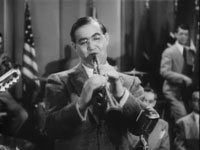
Benny Goodman (1909-1986) was a big band leader and clarinetist who benefited greatly from his association with Fletcher Henderson and his use of Henderson's arrangements. Goodman's band was one of the few white bands regarded as "hot" by black jazz musicians. More than anyone else, Goodman popularized swing for the broader American population, ushering in the era of jazz's greatest popular appeal. He became known as "The King of Swing" due to his unparalleled success in the mid-to-late 30s.
He had the uncanny ability to please the public with hit after hit, as well as keep his musicians actively engaged by maintaining high-level improvisation as a regular part of their performance practice.
Goodman grew up in Chicago, where from an early age he was able to hear many of the great New Orleans and Chicago jazz musicians who performed there regularly. He also studied classical clarinet, which stood him in good stead with the art music community and eventually led to a dual career that saw him record some of the great classical works for clarinet.
First, though, Goodman pursued his passion for jazz, with sideman stints that took him to the West Coast in 1925, back to Chicago in 1926, and then to New York in 1928. Freelance work followed, providing a breadth of experience that also allowed him to develop important professional relationships among musicians and within the recording industry. His association with John Hammond, record producer and talent scout, was especially important. Goodman formed his own big band in 1934, and his orchestra was soon heard coast to coast on the radio1.
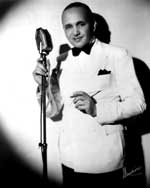
Let's listen now to a Fletcher Henderson arrangement of a Jelly Roll Morton piece, King Porter Stomp ♫ from 1935, which was one of Goodman's early hits. This is the sound of early swing. The band is tight and buoyant, carried along by pronounced accents on the beat that convey a strong two-step feel. We hear this prominently in the piece's opening half minute. Goodman delivers a hot, virtuosic solo that demonstrates his mastery of the clarinet (0:59-1:40), and his star soloist, Bunny Berigan, follows suit on trumpet (1:41-2:02).



Billie Holiday's song God Bless the Child inspired a children's picture book of the same name , which was published by Harper Collins in 2004.
