
Overview
Objectives
- Identify two important figures in early American folk music, Pete Seeger and Woody Guthrie
- Recall why Pete Seeger and Woody Guthrie were inspirational figures in the folk revival of the 1960s
- Examine the music and career of Bob Dylan
- Recall why Bob Dylan's electric performance at the 1965 Newport Folk Festival was so upsetting to folk music purists
- Recall the many stylistic and generic reactions to Dylan "plugging in," namely, the rise of the genre of folk rock
Dylan’s Influence During the 1960s
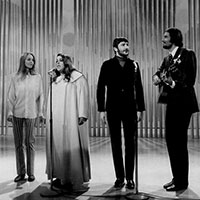
The influence of Dylan’s Newport Festival Performance could be felt immediately in 1965. In the summer and fall of that year, several songs charted that were either covers of Dylan songs or songs written in close imitation of Dylan’s message and style. Two versions of "All I Really Want to Do ♫"—one by the Byrds and another by Sonny and Cher—competed with each other. "Eve of Destruction ♫," recorded by Barry McGuire, is a gruff, sardonic song delivered in close imitation of Dylan’s vocal style. Other groups such as the Mamas and the Papas, Buffalo Springfield, and the Turtles also found success in the new genre of folk rock. These artists recorded music that had a strong message in addition to using rock instrumentation.
Simon and Garfunkel moved effortlessly between folk and folk rock with songs such as the acoustic "Scarborough Fair ♫" and the electric "Mrs. Robinson ♫."
Bob Dylan also affected artists who were not specifically folk or folk rock musicians. In 1964, Dylan visited the Beatles in their New York hotel. Dylan not only introduced the members of the Beatles to marijuana during this visit, but he also encouraged them to explore deeper themes in their music. Within six months of encountering Dylan, John Lennon had begun to imitate Dylan’s vocal style and brittle style of guitar playing. The Beatles "You’ve Got to Hide Your Love Away ♫" clearly shows the influence of Dylan with its strophic form and acoustic guitar accompaniment. Of this song, Paul McCartney said, "It’s just John doing Dylan." Additionally, as we will see in the next lesson, the Beatles began writing music about complex themes during the mid-1960s. While this shift in their style cannot be attributed entirely to their meeting with Dylan, it is clear that they had a conversation during that meeting that corresponded to changes that the Beatles would soon make in their music and their message.



Woody Guthrie became part of the mass migration of dust bowl refugees known as "Okies." Without food or money, Woody hitchhiked, rode freight trains, and even walked to California, developing a love for traveling on the open road -- a practice he would repeat often.
