
Overview
Objectives
- Identify the defining stylistic characteristics of country rock
- Identify the defining stylistic characteristics of Southern rock
- Recall the instrumentation, musical influences and backgrounds, and lyric themes of several country rock and Southern rock artists
Southern Rock continued
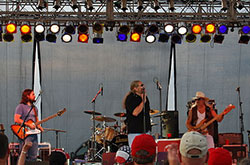
Other Southern rock groups did not feel compelled to copy the instrumentation of the Allman Brothers Band. The Marshall Tucker Band, for example, included one lead guitar, a rhythm guitar, a steel guitar, bass, keyboard, and drums. They also frequently incorporated wind instruments such as saxophone or flute, gestures which reflected their jazz backgrounds. The Marshall Tucker Band’s lyrics celebrate their South Carolina heritage, praising their home state and the South.
On their 1976 album Long Hard Ride, the Marshall Tucker Band invited two guest artists, fiddler Charlie Daniels and banjoist and mandolinist John McEuen, to join them. Charlie Daniels was a successful musician in his own right, and although he recorded with a number of country rock groups during the 1970s, he is typically considered a country musician rather than a Southern rock musician.
The Texas band ZZ Top combined Southern pride, the blues, and psychedelic rock in their music. Billy Gibbons, a singer and guitarist, played with a psychedelic band called Moving Sidewalks, which had opened for the Jimi Hendrix Experience. Gibbons studied Hendrix’s feedback and distortion techniques closely and sought to imitate them in his own music. After he left Moving Sidewalks, Gibbons teamed up with bassist Dusty Hill and drummer Frank Beard.
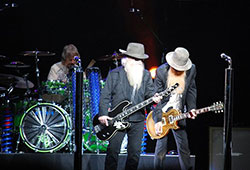
Hill and Beard were former members of a Dallas band called American Blues, and they brought with them the musical traditions for which their band had been named. The self-explanatory ZZ Top’s First Album (1970) was not an immediate commercial success, but it featured prominent guitar distortion from Gibbons, blues-influenced barrelhouse styles, and the humorous innuendo that would continue to characterize the band’s music for decades. Their albums that were released later in the 1970s had more commercial success, charting singles such as "La Grange ♫" (an homage to a brothel in their home state of Texas) and "Tush ♫," a play on the word’s double meaning ("tush" can refer either to buttocks or to a lavish lifestyle). "Tush ♫" is based on the 12-bar blues form, and the guitar solos use the bottleneck technique, both of which are borrowed from the blues tradition. ZZ Top’s Southern imagery focused on scenes from Texas and the American southwest, such as cacti and snakes.
During the early 1980s, the group took a hiatus, during which Gibbons and Hill grew their iconic chest-length beards. (Interestingly, Frank Beard is the only member of ZZ Top who does not have a beard.) In the 1980s, ZZ Top released more commercially-oriented music, such as "Legs ♫" and "Gimme All Your Lovin ♫’." These and other singles from the period were a departure from the Southern rock they had recorded in the 1980s; much of the music from this period included pop instruments such as synthesizer and had greater pop appeal. In the 1990s, however, the group returned to their blues roots and played an increasingly guitar-based style again.



Bob Dylan wrote "Lay Lady Lay" for the 1969 movie Midnight Cowboy, though it was passed over in favor of Harry Nilsson's "Everybody's Talkin'."
