
Objectives
- Recognize the differences between the Medieval and Renaissance periods in terms of society, religion, art, science, and freedom.
- Explain how Renaissance musicians made their living.
- Use relevant musical vocabulary to analyze Renaissance a cappella singing.
- Distinguish the characteristics of Renaissance music, and differentiate between Renaissance music and Medieval music.
- Illustrate how composers used the motet, a sacred genre with a Latin devotional text, to experiment in musical style and texture.
- Describe how Renaissance composers set texts from the Ordinary of the Mass for their polyphonic Masses.
- Describe how instrumental dance music was performed by professional and amateur musicians.
The Renaissance (1450-1600) Social and Cultural Aspects
The Renaissance was a period of great historical change. It is often described as a time when Western society suddenly awoke from the slumber of the Middle Ages. This is not entirely true, however, since all of the changes that took place during the Renaissance are the direct result of social and cultural ideas that had been previously planted. Regardless, it remains a truly unique era in world history.
Events
The following are some of the main events that took place during the Renaissance:
- 1450 - Gutenberg invents the printing press.
- 1453 - End of Hundred Years War, fall of Constantinople to the Turkish army.
- 1454-55 - Gutenberg's first finished copies of the Bible.
- 1492 - Columbus sails for America.
- 1509 - King Henry VIII crowned in England.
- 1513 - Nuñez de Balboa discovers the Pacific Ocean.
- 1517 - Martin Luther's 95 theses begin The Reformation.
- 1519 - Magellan circles the globe.
- 1534 - Church of England separates from Catholic Church.
Each of the events above had a major impact on the balance of power in Europe.
Printing Press
Musicians and composers were among the first to feel the benefit of Johann Gutenberg's printing press. Music could now be printed in large quantities and shipped quickly to other regions of Europe. This new technology enabled the music of an English composer, for instance, to be heard and performed by musicians in Italy shortly after it was composed. Of course, composers now had to work harder to establish a standardized notation system, so that every musician in Europe could read each other's music. The days of copying large music scores were coming to an end.
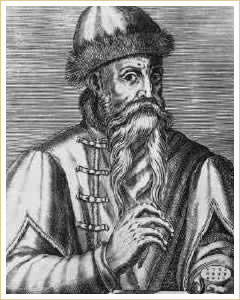

Musicians and composers were among the first who felt the benefit of Johann Gutenberg's printing press...

1453
The year 1453 marks the end of the Byzantine (or Easter Roman) Empire. In that year, the 21-year-old Ottoman Sultan Mehmed "the Conqueror" captured the capital of the empire, Constantinople (modern-day Istanbul), originally known as Byzantium. The fall of Constantinople to the Turks meant that, after East-West conflicts that consumed vast resources for the better part of the previous 1000 years, Europe could now look past the Crusades to less tumultuous times. The fall of Constantinople also meant that traditional overland commerce routes between Western Europe and the Far East were blocked. The need to identify new maritime routes would eventually spur the Age of Discovery.
Explorers
The voyages of great European explorers such as Columbus, Vespucci, Cabot, Nuñez de Balboa, and Magellan led to a more enlightened view of world geography. They also led to unprecedented wealth for some European courts, most notably those of Henry VIII of England and Phillip II of Spain. However, at the same time, the voyages resulted in a period of colonization and exploitation of the native peoples of the Americas and, eventually, a war between England and Spain.
Martin Luther (1484-1526)
The theses of Martin Luther and the schism with the Church of England lessened the power of the Catholic Church. In spite of this, European Church music reached its greatest heights during the Renaissance. Later, as Renaissance courts became wealthier, composers slowly began to find more employment outside of the Church. The balance of power began to shift from the cathedrals of the Church to the courts and palaces of Europe.
The 16th-century philosopher Erasmus said of the age: 'the world is coming to its senses as if awakening out of a deep sleep.
The Renaissance is known as a period of tremendous intellectual awakening and scientific inquiry. The 16th-century philosopher Erasmus said of the age: "the world is coming to its senses as if awakening out of a deep sleep." There was a real sense that the Renaissance world was a dramatically different place than it had been just 150 years before.
Humanism
There was a rebirth of interest in the human spirit as an independent entity, not merely as an instrument through which God worked. The philosophical realization that humans could achieve their destiny here on Earth rather than in an afterlife had a profound impact on developments in both science and the arts. Humanism, as this new ideal has been labeled, inspired artists to represent the human form and physical world as accurately as possible. At the same time, it inspired Leonardo da Vinci (1452-1519) and Galileo Galilei (1564-1642) to learn more about the physical universe and the human body. However, none of the advances of the Renaissance would have been possible without the earlier, quiet developments of the Middle Ages. For example, the scientific inquiry of the Renaissance took place in European universities that had been founded in the Middle Ages, and the relatively stable political climate of the Renaissance would not have been possible without 8th and 9th century contributions of Charlemagne or the establishment of the medieval city-states.



