
Objectives
- Relate how Romantic poets and artists abandoned traditional subjects, turning instead to the passionate and the fanciful.
- Relate how the Industrial Revolution impacted the technological development and affordability of musical instruments.
- Analyze how the orchestra grew in size and sound as new instruments were introduced and composers demanded greater levels of expression.
- Illustrate how Romantic composers explored nationalistic folklore and exotic subjects.
- Identify the form of romantic period songs, including strophic, through-composed, and the modified strophic forms.
- Examine the German art song (or Lied) as a favored romantic period genre.
- Discuss how the music of Franz Schubert impacted romantic period music.
- Discuss how the music of Frédéric Chopin impacted romantic period music.
- Trace the ascendance of program music in relation to absolute music.
- Summarize how political unrest throughout Europe stimulated the formation of schools of musical nationalism in Russia, Scandinavia, Spain, England, and Bohemia among other countries.
- Differentiate between the distinct national styles of romantic opera in France, Germany, and Italy.
- Discuss how the Italian nationalist composer Giuseppe Verdi impacted romantic period music.
- Trace how choral music became a popular artistic outlet for the middle classes.
- Discuss how the Russian composer Pyotr Ilyich Tchaikovsky impacted romantic period musi
The Romantic Period (1820-1910) Social and Cultural Aspects
A Time of Change
The Romantic era in music occurred during a time of great change in Europe. Art produced during this period reflects the sense of change and contradiction that was felt all over the world as wars and revolutions forced power to change hands, oppression gave way to freedom, capitalism struggled with socialism, and science battled organized religion. No longer constrained by the rules of the Classical era, artists gave free rein to individual expression, and strove to reflect the tensions that surrounded them.
World events altered all aspects of European life. The French Revolution (1789-1793) transformed France’s social and political structure. The loss of the American colonies in the American Revolution changed England economically, politically, and socially. Governments came and went in Italy, where Austria ruled for many years. Germany suffered through several ineffective regimes. Spain lost many Latin American colonies to revolutions led by Simón Bolivar and, later, in the Spanish-American War (1898), lost vast territories in North America as well. Institutions, such as the church, that had once dominated European life lost much of their remaining power. In addition, the influence of the aristocracy declined or, in some cases, disappeared entirely.
Monarchies all over Europe were being challenged by new political and philosophical thought including the ideas of Karl Marx and other revolutionary leaders. In place of the monarchies new governments arose which were, in some places, more democratic and, in others, more authoritarian.
At the turn of the century, Napoleon Bonaparte emerged as the leader that people thought would lead Europe into a new age of brotherhood and equality. However, as emperor, he soon revealed his determination to dominate Europe. After a reign of eleven years as Emperor of France, Napoleon was finally defeated at the Battle of Waterloo in 1815.

The defining event in Europe was not a single event at all, but a gradual redefinition of the economic structure of the entire continent...

Governments came and went in Italy (where Austria ruled for many years), while Germany suffered through several ineffective regimes. The defining event in Europe was not a single event at all, but a gradual redefinition of the economic structure of the entire continent. As people began to move into cities, the Industrial Revolution brought about great change in wages, productivity, and demographics.
Sociocultural influences on artists
Beethoven died in March of 1827 in Vienna. He was 56. The last of the great classical composers, he was also the first of the Romantics. The start of the Romantic movement in music traditionally dates from his death. Beethoven had broken just about every rule, and no one that lived after him could be anything but aware of his legacy. Not only did he change the face of music, he changed its image. He started the cult of the composer as an individual and refused to accept that the artist was subservient to his patron, as Mozart had been only some 15 years earlier. Beethoven showed that the creative artist was above all that. Music should be made for music's sake. This was to become a cornerstone of the Romantic creed.
Romantics rejected the supposedly cold, intellectual, logical approach of the classical period. Instead, they trusted in the instinctive truth of their own emotions...
Romanticism began at the end of the 18th century as a literary concept, and was more of an attitude of mind than an actual code. Romantics rejected the supposedly cold, intellectual, logical approach of the classical period. Instead, they trusted in the instinctive truth of their own emotions. Rules no longer circumscribed what could be achieved.
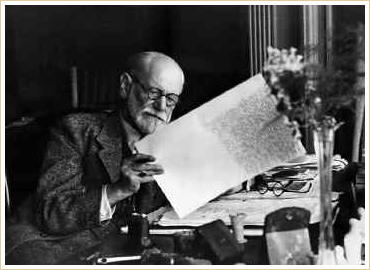
The 19th century in Europe was an era of enormous progress, especially in science. Steam engines were invented, and railways began to crisscross the landscape. Louis Pasteur (1822-1895) developed and proved the theory that germs cause disease, invented pasteurization, and developed vaccines for deadly diseases including rabies. In 1859, Charles Darwin (1809-1882) laid the foundation of evolutionary theory in his work On the Origin of Species, which presented his complete theory of natural selection. In 1899, the Viennese neurologist Sigmund Freud (1856-1939) laid the foundation for psychoanalytic theory in his most important work The Interpretation of Dreams. His work had a profound influence on 20th century art, especially on the surrealists, who, in their effort to gain access to the secrets of the unconscious, created new art forms and techniques.
Freud's work had a profound influence on 20th century art, especially on the surrealists who, in their effort to gain access to the secrets of the unconscious, created new art forms and radically new techniques...
During the Romantic era, industry became paramount. The men who became the pillars of 19th century society were the new men: the bankers, the politicians, the generals, and the industrialists. Few had time for music unless it was for a ceremonial occasion. The old relationship between the artist and his patron vanished. The artist was now an outsider, a rebel. He was often a virtuoso performer, and could also be a showman, a personality. No longer required simply to turn out notes by the yard as a result of a commission, he could write to please himself. That meant looking inwards for inspiration. His own feelings and his thoughts became paramount. Life was art, and art was life.
While compared to that in the 20th century the standard of living was still extremely low, higher wages allowed more people to enjoy musical luxuries, such as learning an instrument or attending a concert. A rising middle class joined civic choruses, bands, and choral societies; in fact, choral music enjoyed its highest popularity since the Renaissance with the emergence of such choral groups. Johannes Brahms, Hector Berlioz, Giuseppe Verdi, and Felix Mendelssohn, are among the important choral composers of the 19th century that benefited from this trend.
While compared to that in the 20th century the standard of living was still extremely low, higher wages allowed more people to enjoy musical luxuries, such as learning an instrument or attending a concert...
The dissolution of the aristocracies and the rise of the Industrial Revolution meant that composers had to find new ways to earn a living. The days when composers such as Haydn could live off the patronage of a royal family or work for the church for their entire career were over. Instead, composers now needed to earn their livelihood by performing, writing and publishing music, or from commissions. Some composers such as Franz Schubert (1797-1828), struggled under this new order of things. Liszt (1811-1886) and Chopin (1810-1849) traded on their fame as performers and Robert Schumann (1810-1856) on his reputation as a critic to finance their primary interest, which was composing. Still others, including Donizetti, accommodated their compositions to public taste, knowing that the success of one piece meant the probability of being able to sell another.
The Romantic Aesthetic
The Romantic aesthetic was based on the belief that each human is a unique individual, with a distinctive creative voice and vision. Although these visions were as diverse as the artists themselves, several themes emerged in the artistic and social thought of the period: 1) An understanding of the importance of the individual in society, 2) An interest in the supernatural, 3) A renewed interest in nature, and 4) An emotionally charged mode of expression.
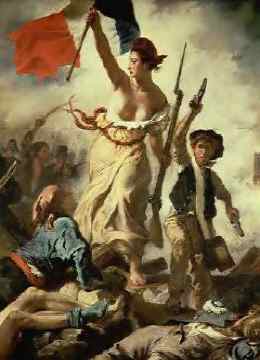
All the arts felt the influence of the Napoleonic ideals of liberty, equality, and fraternity...



Brahms attempted to retire early at age 57, but continued composing until his death seven years later
