
Objectives
- Outline the social, cultural, and political impact of WWI and WWII.
- Discuss the growth of the United States as a world power.
- Describe the impact of technological advancements on the development of music in the twentieth century.
- Describe, compare and contrast the main stylistic differences of Contemporary music styles including impressionism, post-Romanticism, serialism, and expressionism.
- Summarize the changing nature and application of the concept of tonality throughout the century.
- Discuss the impact of Claude Debussy's "Prelude to the Afternoon of a Faun" in light of the Symbolist movement in literature.
- Illustrate how the Russian composer Igor Stravinsky experimented with rhythm, new instrumental combinations, and the percussive use of dissonance, and discuss the impactof these techniques on contemporary music.
- Describe the impact of Arnold Schoenberg and the Second Viennese School on 20th-century music.
- Distinguish the main stylistic differences of nineteenth- and twentieth-century composers and styles.
- Describe the musical and political impact of “national schools” of composition that developed across Europe during the 20th century.
- Explain the impact of composer Aaron Copland on American contemporary music.
- Describe the impact of Latin American composers on the larger "art music" scene and repertoire.
- Define and analyze the main differences between jazz, ragtime, and blues.
Contemporary Period (1910-present): Latin America, Russia, and the United States
Latin America
Before 1492, music in the New World was exclusively created by Native American peoples including the North American tribes, the Incas, Mayans, and Aztecs of Central and South America, and the outlying tribes of the Amazon rainforest. Within 100 years after Columbus arrived in the Caribbean, the Aztecs had been wiped out, the English and French had established colonies alongside the Spanish and Portuguese, European diseases had decimated the native populations, and Africans had been brought in as slave labor, particularly along the eastern seaboard. As a result, the music of the Native American people was replaced in many areas by European or African music. Native American music still exists in its original form only in very few, isolated places that European settlers could not reach—the heights of the Andes mountains along the western seaboard, and deep in the Amazon rainforest.
Therefore, particularly in the areas where the European population absorbed Indian populations, Latin American music became a mixture of three cultures: Native American, European, and African. Where slave trade ships first landed (Brazil (samba) or Cuba (mambo, son)) the African influence predominates. In Perú (huayno) and Bolivia, more of the original Indian sound may be heard. In Argentina (tango) and Mexico (mariachi, norteño), the influence of European music is most evident.

Native American music still exists in its original form only in very few, isolated places that European settlers could not reach—the heights of the Andes mountains along the western seaboard, and deep in the Amazon rainforest...

In the 20th century, Latin American composers, like their peers in the United States, began to find their own voice. While many of the finest musicians such as Antonio Carlos Jobim (1925-1994) and Gilberto Gil (b. 1942) pursued careers in their native traditions, often to popular acclaim, many others chose to compose art music with a strong nationalistic flavor.
Heitor Villa-Lobos (1887-1959) was a samba guitar player from the streets of Rio de Janeiro who became Brazil’s greatest (and most prolific) composer. His series of works entitled Bachianas Brasilieras combined the rhythms and dances of Brazilian music with forms found in the music of J.S. Bach. In El Trenecito, the second movement from the Bachianas Brasilieras No. 2, he attempted to reproduce the sound of a train ride into the Amazon rainforest. His guitar works, such as the mysterious Etude No. 11 are among the greatest in the guitar repertoire. Carlos Chavez (1899-1978) of Mexico and Alberto Ginastera (1916-1983) of Argentina also introduced classical works with a Latin American flair (such as Ginastera’s Malambo) to the musical world stage. Today, the sounds of Latin America enter American homes via radio, television, movies and the Internet. Today, many Latino composers are counted among the great living musicians.
Composer: Heitor Villa-Lobos
-
"Étude No. 11"
Composer: Alberto Ginastera
-
"Malambo"
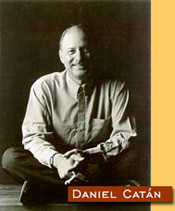
Composers like Daniel Catán (1949-2011), whose opera Florencia en el Amazonas premiered at the Houston Opera in 1996, utilize contemporary techniques freely and fluidly to create music of matchless beauty. Listen again to the dialogue between Arcadio (Tenor) and the boat captain (Bass), and appreciate the sensous melodic phrases, and lush string and woodwind sonorities that provide the perfect sound canvas for the two the male voices. Primarily a composer of operas, his subject matter is frequently derived from works that belong to the South American literary movement known as magical realism. Some of his sources have included Nathaniel Hawthorne, Octavio Paz, and Gabriel García Márquez.
Born in Mexico City in 1949 of Russian Sephardic Jewish descent, Catán spent his first 14 years in Mexico before relocating to England to study philosophy and music. After several years at Sussex and Southampton, Catán moved to the United States, where he earned his Ph.D. at Princeton under the tutelage of Milton Babbitt (1916-2011). Having spent just as many years outside of Mexico as he had inside, he returned to Mexico City in 1977 to rediscover his Spanish-speaking roots; there, he served a term as Music Administrator at the Palace of Fine Arts. In 1994, San Diego Opera premiered his work Rappaccini's Daughter, launching a successful opera career in the United States that included works such as Florencia en el Amazonas, Salsipuedes, and Il Postino.
Composer: Daniel Catán
-
"Florencia en el Amazonas: Act 1, Scene 3"
Russia
At the time of the Russian revolution, Stravinsky and Rachmaninov had already established and solidified their outstanding reputations. Therefore, they were both able to travel freely between the new Soviet Union and Europe. For younger composers, however, a restrictive period soon cast a pall over Russian music that lasted until the fall of the Soviet Union in 1989.
The two principal composers in the Soviet Union after the Russian Revolution were Sergei Prokofiev (1891-1953) and Dmitri Shostakovich (1906-1976).
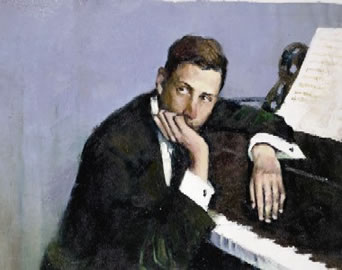
Prokofiev lived outside of the Soviet Union until 1934. His early works, such as the Classical Symphony (1918) and the opera Love for Three Oranges (1921), are characterized by an awareness of Neo-Classicism, as well as of surrealism and abstraction. His later works show his concern for public approval, the result of the brutal iron hand of Soviet dictator Joseph Stalin.
Composer: Sergei Prokofiev
-
"Symphony No. 1 in D Major, Op. 25, "Classical": I. Allegro"
Composer: Sergei Prokofiev
-
"The Love for Three Oranges, Op. 33bis: III. March"
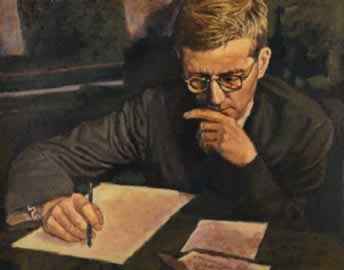
Stalin’s dictatorship had a far greater impact on Shostakovich. His memoir, Testament, tells stories of artists, composers, and writers who, after writing something that displeased Stalin, disappeared in the middle of the night, never to be seen again. As a result, Shostakovich’s larger works, like the brilliant Symphony No. 5, are Post-Romantic pieces, which reflect the conservative bent of the authorities, with only a touch of modern rhythmic or harmonic treatment. Only in his smaller works, like the String Quartet No. 8, did he dare to be more modern, since these works were less likely to draw Stalin’s attention.
Composer: Dmitri Shostakovich
-
"Symphony No. 5 in D Minor, Op. 47: IV. Allegro non troppo"
Composer: Dmitri Shostakovich
-
"String Quartet No. 8 in C Minor, I. Largo"
Shostakovich's memoir, Testament, tells stories of artists, composers nd writers who, after writing something that displeased Stalin, disappeared in the middle of the night, never to be seen again...
The United States
In the United States, while jazz was sweeping the nation, art music composers were, for the first time in history, establishing themselves as premiere world figures. Composers like Walter Piston (1894-1976) and William Grant Still (1895-1978), with a comparatively minimal amount of nationalism, began a tradition of compositional excellence. Of particular interest is Still’s Afro-American Symphony based on blues music.
Copland is arguably the greatest American composer of the 20th century...
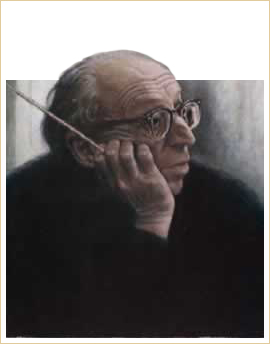
Aaron Copland (1900-1990) is arguably the greatest American composer of the 20th century. Born in New York and educated in Paris with Nadia Boulanger, his first works, including a Piano Concerto (1926) and Short Symphony (1933), combine jazz and elements of Neo-Classicism. It was in the orchestral works such as A Lincoln Portrait (1942), Fanfare for the Common Man (1942), and the ballet scores for Billy the Kid (1938), Rodeo (1942), and Appalachian Spring (1948) however, that Copland emerged as the composer most adept at capturing the American spirit. His use of chords with open fifths, his American folk melodies and his countless fiddle tunes evoke the open spaces of the American frontier. In his late works, like the Twelve Poems of Emily Dickinson (1950) and Inscape (1967), he adapted serial techniques to his own compositional style.
Composer: Aaron Copland
-
"Fanfare for the Common Man"
Composer: Aaron Copland
-
"Rodeo: Hoe-Down"
Composer: Aaron Copland
-
"Billy the Kid"
Composer: Aaron Copland
-
"Appalachian Spring"
Charles Ives
At the same time that Schoenberg and Stravinsky were relentlessly pursuing new sounds in Europe, Charles Ives was doing the same in America—but practically in secret. As he once put it, if a composer "has a nice wife and some nice children, how can he let them starve on his dissonances?" Rather than concerning himself with whether or not his radical works would be accepted (and pay the bills), Ives built a successful areer in life insurance and composed only during evenings, weekends, and holidays. The result was two health breakdowns, the second (when he was 44) serious enough to put an end to his tremendous productivity in both areas. Before that happened, however, Ives composed cutting-edge music that infused European forms with a uniquely American spirit.
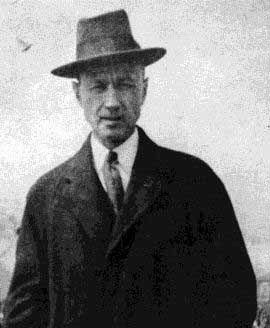
Born: 1874
Died: 1954
Period: Contemporary
Country: USA
A musical prodigy who was composing by the age of thirteen, Charles Ives grew up in Danbury, Connecticut. His father George had been an acclaimed band leader in the Civil War, and on his return became very influential in promoting music across the northeast region where he lived. George was a powerful influence on his son, encouraging him to follow his natural inclination to experiment musically even while studying the keyboard and other instruments in a disciplined way. The elder Ives had young Charles sing in one key while he accompanied in another; built instruments that could play pitch increments even smaller than half steps (common in some non-Western musical cultures, but not a part of the Western musical language); and he marched two bands around a park playing different tunes, so he and his son could hear how the music sounded when they passed each other. Listen how this early experience is reflected in his Country Band March, written many years later:
Composer: Charles Ives
-
"Country Band March"
From his father, Ives also inherited a deep respect for the popular and patriotic songs of the day, recognizing the expressive content of amateur musicians' efforts and the power of all kinds of music to move and unite people. Though Ives would go on to compose complex works that challenged listeners and stretched the boundaries of classical melody, harmony, and rhythm, he also managed to infuse them with echoes of musical life in a small town and strains of popular, distinctly American tunes. These characteristics are evident in the two examples you are about to hear.
Composer: Charles Ives
-
"Symphony No. 2: Symphony No. 2: IV. Lento maestoso"
Composer: Charles Ives
-
"The Unanswered Question"
Ives took his first job as organist at age 14. He continued to work playing the organ throughout his four years at Yale (1894–1898), where he studied with the noted European-trained composition teacher Horatio Parker, Yale's first professor of music. Instead of going on to study at a European conservatory and furthering an extremely promising musical career, Ives took to heart some last words of advice from his recently deceased father, went to New York City, and sought out a "sensible" job in insurance. In choosing this path, he carved out a very different musical life from that of other composers of his caliber. It brought the disadvantages of a backbreaking workload and isolation from other composers and performers, but it also allowed him to compose and experiment exactly as he wished. He hired musicians to perform his works so that he could hear and revise them, and through the years he showed his works to other composers, most of whom reacted with scorn. It was not until the 1930s, after he had ceased to compose, that his image as the pre-eminent American composer of his generation began to emerge.
In 1922, Ives published a volume entitled 114 Songs, an unmistakable sign of the importance that the genre played in his compositional output. Despite the fact that his wider reputation now rests on his orchestral, chamber, and piano music, it is the songs that represent the heart of his creative thinking. In its cavorting, tonally vague piano writing and text that poses a question at once frivolous and earnest, "1, 2, 3" (1921) represents the essential Ives, and thus makes for an ideal piece for us to hear.
Composer: Charles Ives
-
"1, 2, 3"
Ives took up a number of American, particularly Northeastern, themes in his works. About 1910 he decided to write some orchestral works celebrating his favorite New England writers and began an "Emerson" Overture for Piano and Orchestra, a "Hawthorne" Piano Concerto, and an "Alcott" Overture. He soon abandoned these but reworked their music as a piano sonata in three movements with the titles "Emerson," "Hawthorne," and "The Alcotts," later adding a fourth, which he titled "Thoreau." In 1920–21 he completed the resulting work—the Piano Sonata No. 2, Concord, Mass., 1840–1860—printed at his own expense, together with a short book, Essays Before a Sonata, which you may read here.
Ives characterized the Concord Sonata as "a group of four pieces, called a sonata for want of a more exact name... The whole is an attempt to present [one person's] impression of the spirit of transcendentalism that is associated in the minds of many with Concord, Mass., of over a century ago". It was, however, a very special piece for Ives, as Howard Boatwright, editor of Ives's Essays, pointed out:
For some composers, one work... may become a channel through which the streams of philosophical concept, musical technique, and style flow in singular unity. For Charles Ives, the Concord Sonata was such a work... It is representative of Ives' highest achievements in richness of harmony and freedom of rhythm, and it is stamped unmistakably... with the highly individual personality of the composer.
Each movement of this physically demanding work quotes Beethoven's famous Hammerklavier Sonata (No. 29)—also deemed unplayable at one time. In addition, Ives includes quotes from Beethoven's Fifth Symphony, two Wagner operas, some Debussy, and a number of American popular and religious melodies. The third movement, entitled "The Alcotts," is one of his most lyrical and accessible works.
Missed Audio: "Sonata No. 2, Concord, Mass., 1840–1860, Movement III: The Alcotts"
In 1947, Ives won the Pulitzer Prize for his Third Symphony, subtitled The Camp Meeting. Before his death in 1954, he had at least seen widespread critical acceptance of his music, and he had the satisfaction of knowing that the money earned in his remarkably successful business was put to good use in support of progressive new music.
Further Listening: Contemporary Period
- Schoenberg - Five Piano Pieces, Op. 23, No. 2
- Stravinsky - Le Sacre du Printemps (The Rite of Spring)
- Bartók - Music for Strings, Percussion & Celesta
- Britten - This Little Babe from Ceremony of Carols
- Honegger - Laudate Dominum
- Poulenc - Violin Sonata
- Prokofiev - Symphony No. 1, Classical, 1st movement
- Shostakovich - String Quartet No. 8, 1st movement
- Copland - Hoedown from Rodeo
Composer: Dmitri Shostakovich
-
"String Quartet No. 8 in C Minor, I. Largo"
Composer: Aaron Copland
-
"Rodeo: Hoe-Down"
Composer: Sergei Prokofiev
-
"Symphony No. 1 in D Major, Op. 25, "Classical": I. Allegro"



Ralph Vaughan Williams was the great-nephew of Charles Darwin and the great-great-grandson of Josiah Wedgwood
