
Objectives
- Outline the social, cultural, and political impact of WWI and WWII.
- Discuss the growth of the United States as a world power.
- Describe the impact of technological advancements on the development of music in the twentieth century.
- Describe, compare and contrast the main stylistic differences of Contemporary music styles including impressionism, post-Romanticism, serialism, and expressionism.
- Summarize the changing nature and application of the concept of tonality throughout the century.
- Discuss the impact of Claude Debussy's "Prelude to the Afternoon of a Faun" in light of the Symbolist movement in literature.
- Illustrate how the Russian composer Igor Stravinsky experimented with rhythm, new instrumental combinations, and the percussive use of dissonance, and discuss the impactof these techniques on contemporary music.
- Describe the impact of Arnold Schoenberg and the Second Viennese School on 20th-century music.
- Distinguish the main stylistic differences of nineteenth- and twentieth-century composers and styles.
- Describe the musical and political impact of “national schools” of composition that developed across Europe during the 20th century.
- Explain the impact of composer Aaron Copland on American contemporary music.
- Describe the impact of Latin American composers on the larger "art music" scene and repertoire.
- Define and analyze the main differences between jazz, ragtime, and blues.
A Brief Look at Popular Music
One of the most important musical developments in the 20th century has been the growth in complexity of and recognition for popular music. The roots of american music and of the many different types of music and popular entertainment that evolved over time—jazz, blues, gospel, country/western, rock and roll, acid rock, punk rock, hip-hop, etc.—would fill another entire course!
While it is true that the fascinating history of popular music lies beyond the scope of this course, there has been such a strong connection between jazz, rock, and the world of art music, that we must therefore include a brief overview of 20th century popular music within the larger context of contemporary music.
Jazz
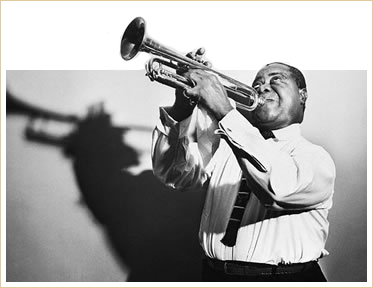
Jazz evolved as a product of four different types of music from the American South: blues, spirituals, work songs, and ragtime. In 1900, Joplin’s Maple Leaf Rag, featuring a new piano style characterized by rhythmic complexity and syncopation, was published and immediately became a bestseller. Listen to The Rose Leaf Rag, originally a ragtime piano piece by Scott Joplin (1868-1917), played by a clarinet ensemble. Jazz soon followed with the "Dixieland" sounds of Ferdinand "Jelly Roll" Morton (1890-1941) and Louis Armstrong (1901-1971). In the 30s, jazz grew more sophisticated with the "Big Band" arrangements of musicians like Edward Kennedy "Duke" Ellington (1899-1974) and Benny Goodman (1909-1986).
Composer: Scott Joplin
-
"Rose Leaf Rag"

Jazz evolved as an product of four different types of music from the American South: blues, spirituals, work songs, and ragtime...

Art music composers noted these developments and tried to find ways to incorporate jazz into their own style, with varying degrees of success. Stravinsky, Milhaud, and Copland all experimented with pieces based on jazz rhythms. The composer who combined the sounds of jazz and art music most successfully, however, was George Gershwin (1898-1937), a composer whose music extended from the Broadway stage to concert works such as An American in Paris and his masterpiece for piano and orchestra Rhapsody in Blue. His folk opera Porgy and Bess is one of the most successful examples of the marriage of classical form and popular style.
Composer: George Gershwin
-
"An American in Paris"
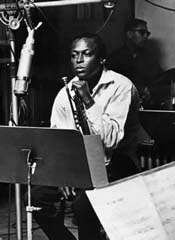
After World War II, jazz groups became smaller with more emphasis on improvisation. This period, commonly called bebop, established jazz as a serious art form rather than merely a popular diversion. Performers like Charlie "Yardbird" Parker (1920-1955), John Coltrane (1926-1967), Miles Davis (1926-1991), and Thelonious Monk (1917-1982) are among the greats of the bebop period. Jazz has changed little since then, with the exception of Latin Jazz (as introduced by Antonio Carlos "Tom" Jobim (1927-1994) and Stan Getz (1927-1991) and practiced by Poncho Sanchez (b. 1951) and Arturo Sandoval (b. 1949) and fusion, a marriage of jazz and rock rhythms found in the music of Chick Corea (b. 1941) and in Miles Davis' later works. Today jazz can be heard in any of its original forms: Dixieland jazz, Big-band jazz, straight-ahead jazz (usually referring to bebop), Latin jazz, or fusion.
Musical Theater
When the art music world turned away from tonality, it brought opera with it. Opera, which had been the most popular form of musical entertainment throughout the 19th century, was deemed too ‘heavy’ for much of the music-listening public. Operas of the 20th century, such as Berg’s Wozzeck or Britten’s Peter Grimes, were not readily appreciated despite their now seemingly obvious genius.
In the waning years of the 19th century, audiences turned away from Wagner towards the lighter operettas of Gilbert and Sullivan and John Phillip Sousa (1854-1932). By the first decade of the 20th century, popular, live entertainment reached a peak in American culture. Lighter forms of entertainment, nowadays known as musical theater, found a home on Broadway in New York. In musical theater, songs are interspersed within spoken dialogue. During the early years, Victor Herbert (1859-1924) and George M. Cohan (1879-1942) were its leading composers.
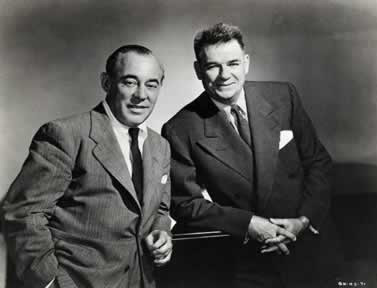
In the 1930s and 40s, new composers and lyricists like Richard Rodgers (1902-1979), Oscar Hammerstein (1895-1960), Lorenz Hart (1895-1943), and Jerome Kern (1885-1945) produced hit after hit with such recognizable titles as Showboat, Guys and Dolls, Carousel and Oklahoma. By the end of World War II, Broadway had become the hub of the popular theatrical music scene. Most of the popular melodies heard on the radio originated from Broadway shows, or were written by musical composers such as Cole Porter (1862-1964), Irving Berlin (1888-1989), or Hoagy Carmichael (1899-1981). Musicals such as 42nd Street and Ain’t Misbehavin’ incorporated elements of jazz into the musical mainstream.
By the end of World War II, Broadway had become the hub of the popular theatrical music scene...
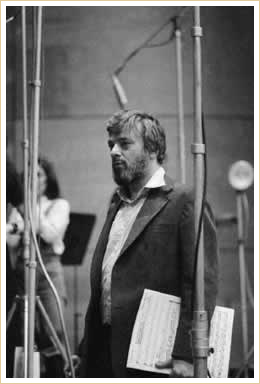
In the 1950s, musical theater matured in works like Leonard Bernstein’s (1920-1989) Candide and West Side Story. Not only are the musical elements of Bernstein’s works more complex, but also the librettos are darker, more morose, and temperamental than that of his predecessors. West Side Story, perhaps the most influential work in American musical theater, is a resetting of Shakespeare's Romeo and Juliet into New York City in the 1950s. Stephen Sondheim (b.1930), the greatest living musical theater composer and lyricist (he worked on West Side Story), continued Bernstein’s tradition with a series of musical hits including A Funny Thing Happened on the Way to the Forum (1962) and Sweeney Todd (1979). More recently, Andrew Lloyd Webber (b. 1949) and others have introduced rock music into the theater with varying degrees of success.
Rock
The term rock music is a catchall phrase that is quite often misused. It generally refers to any form of popular music since 1955, and is used to describe a wide range of divergent artists from the Grateful Dead to Marvin Gaye, Bobby Darin to Limp Bizkit, and Led Zeppelin to Public Enemy. Rock music has spawned dozens of different sub-genres, each of which may apply to only a handful of artists.
It is probably best to consider rock music (or rock and roll as it was known originally) as a particular subset of popular music that originated as a combination of Gospel music, country and western, blues (and its offshoot, rhythm and blues) and jazz in the 1950s. General musical characteristics of rock include a strong reliance on guitar, bass, and drums, limited improvisation, and relatively short song structures. The introduction of rock music into mainstream popular culture shocked the American populace out of the political and social complacency of the 1940s and 50s. Loud music, dominated by the electric guitar, sexually charged dancing, inspired in part by Elvis Presley’s (1935-1977) hip girations, and politically aggressive movements promoting social efficacy all combined to produce both a music and a lifestyle that first scandalized, then forever altered American perceptions of self and of music. This rebellious, socially aware characteristic of rock music distinguishes it from its gentler pop music cousins.
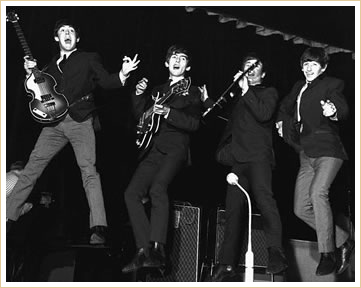
Unlike art music, rock music consistently demonstrates a tremendous social impact. Furthermore, in ia slightly altered form, this trend continues today. Just as the music of The Beatles and many other 60s groups had a perceptible effect on attitudes towards the Vietnam War, government, and civil rights, the hip-hop movement in the 90s has changed the way listener’s dress, talk, and appreciate music.
Music for Film
When the motion picture was first introduced to the public, recorded sound was not available. Live music, usually an organ or an upright piano accompanied silent films in the theater;this accompaniment required extreme skill.
With the introduction of spoken, recorded dialogue (first used in The Jazz Singer), the responsibility for film music transferred from performer to composer. Furthermore, although the role of technology and of music in film has significantly changed over the decades, the process of writing music for film has remained essentially the same. Film composers write two kinds of music: pre-production and post-production. Pre-production is music that is needed to accompany some action in the film: dancing, background musicians on stage, etc. Films that revolve around music (The Sound of Music, The Mambo Kings, Amadeus, La Bamba) require a great deal of pre-production music. The majority of music written for films, however, is added in post-production, after the film has been edited to enhance the emotional content of the film.
Historically, early film composers were employees of the large studios. Most early film music is simple and uncomplicated; however, a few bold composers, unafraid to use 20th century compositional techniques, emerged and greatly affected later musical cinema. Two early giants in film music are Max Steiner (1888-1971) and Erich Korngold (1897-1957). Steiner’s numerous film credits include music for the original King Kong (1933) and the Three Musketeers. Korngold, who wrote music for several films including Captain Blood, was one of several “art” music composers (including Honegger, Shostakovich, and Vaughan Williams) who turned to film music as an extension of concert work.
Two other important early film composers are Alfred Newman (1901-1970) and Bernard Herrmann (1911-1975). Newman’s scores include the music to Captain from Castile, The Hunchback of Notre Dame, Wuthering Heights, and Airport. Newman’s musical descendants include Randy Newman (Toy Story) and Thomas Newman (American Beauty). Herrmann was one of the first film music composers to successfully introduce 20th century techniques as a way of heightening tension in suspense films. In addition to the music for Garden of Evil (starring Gary Cooper, Susan Hayward, and Richard Widmark), he wrote music for Orson Wells (Citizen Kane), Alfred Hitchcock (Psycho), and Martin Scorsese (Taxi).
Recently, there has been a trend towards incorporating non-original music into a motion picture. For example, Samuel Barber’s Adagio for Strings is liberally used throughout the movie Platoon (1986). Some of the many movies that have made abundant use of previously existing music are A Clockwork Orange, 2001: A Space Odyssey, and The Truman Show. Often, this is done for purely financial reasons. Studios can profit greatly from the sales of a successful film soundtrack; therefore, music supervisors have become powerful music figures. Being selected for a movie can make or break a band, song, soundtrack, movie, or career.
Throughout all of the changes in composition and music, the role of the composer remains the most integral. A memorable, emotionally stirring piece of music can add significance to a film that would not otherwise possess. John Williams (Star Wars), James Horner (Titanic), Danny Elfman (Batman), Stanley Myers (The Deer Hunter), or Ennio Morricone (The Mission) are among those composers who understand the needs of the film and the ways in which music can fulfill them. Myer’s piece "Cavatina" from The Deer Hunter is an excellent example of how music, when well written and carefully positioned, can enhance the poignancy of a film.
Composer: Max Steiner
-
"King Kong"
Composer: Alfred Newman
-
"Captain from Castile: Conquest, Triumphal March"
Composer: Samuel Barber
-
"Adagio for Strings, Op.11"
Composer: Stanley Myers
-
"Cavatina"



Olivier Messiaen wrote and premièred his ‘Quartet For The End Of Time’ while imprisoned in a Nazi prison camp.
