
Learning Objectives
- Define compound meter as a meter which subdivides the beat into three rather than two equal parts.
- Learn how to interpret compound time signatures.
Meter Types V: Compound Meter
Simple and Compound Division
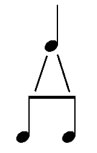
We already know that in simple meter each beat is divided into two equal parts. For example, if the beat is a quarter note, then each quarter note can be divided into two eighth notes, as shown here:
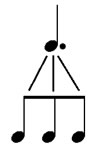
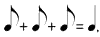
In compound meter, the beat is divided into three equal parts (instead of two). Because of the three-part division, the beat in compound meter is always a dotted value. For example, if we were to divide the beat into three eighth notes, what rhythmic value could we use to represent the beat? A dotted quarter note is equal to three eighth notes, so we can use this dotted value to represent the beat, as illustrated below.
| Remember |
|
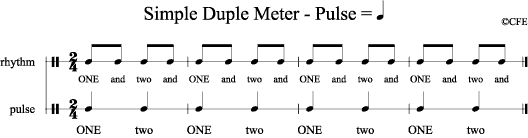
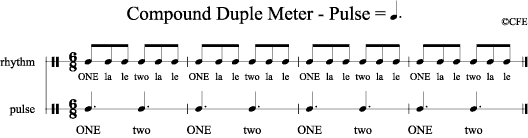
The following two examples illustrate the division of the beat in simple and compound duple meters. The first is in 2/4 (a simple duple meter) with a quarter-note beat. The second is in 6/8 (a compound duple meter) with a dotted quarter-note beat. Both have two beats per measure, but the first example has four divisions per measure (2 x 2 = 4) while the second example has six divisions per measures (2 X 3 = 6). The examples also illustrate that the counting system in compound meter is different than in simple meters (using ONE la le TWO la le rather than ONE and TWO and). Click on the two examples to compare them.

Compound Time Signatures
Another important distinction between compound and simple meters is that compound time signatures do not work in the same way as simple time signatures. In simple time signatures the top number tells us the number of beats per measure and the bottom number indicates the value of each beat. If we were to apply the same rule to a compound meter time signature—such as six-eight—the top number six (6) would indicate that there are six beats per measure, and the bottom number (8) would indicate that each beat is an eighth note. But this is not correct. There are two beats in six-eight, not six. Six-eight is a duple meter.
Let's examine why compound time signatures cannot work in the same way as simple time signatures. We could use a 2 as our top number in compound duple to indicate that there are two beats in the measure. But what number would we use on the bottom? What number would represent a dotted quarter note? Since the beat in compound meter is always a dotted value, it does not translate directly into a number, as do the beat values in simple meter. Because of this, compound time signatures are always based on the division of the beat rather than the beat itself.
| Remember |
|
Thus, in compound time signatures, the top number does not represent the number of beats per measure. Instead, it tells us the number of divisions of the beat per measure. To find out how many beats there are in each measure, you can divide the top number by three (3). For example, in six-eight meter the top number is 6, telling us that there are six (6) equal divisions of the beat in each measure. The number of beats per measure is six divided by three, which equals two. Thus there are two dotted-quarter note beats per measure.
| Remember |
|
The bottom number in a compound meter time signature does not represent the note value of the beat itself, because there is no simple numerical representation for dotted note values. Instead, it represents the note value of the division of the beat. For example, the bottom number (8) in the six-eight time signature tells us that the value of the division of the beat is an eighth note. Since the beat is equal to three of these divisions, to figure out the value of the beat, you would add together three eighth notes, resulting in a dotted quarter. Another way of doing this would be to (1) go up one note value from the division and (2) add a dot. For example, in six-eight time, you would (1) go up from an eighth note to a quarter note, and (2) add a dot to that quarter note. Again, the value of the beat is a dotted quarter note.
| Remember |
|


Summary
The example below illustrates the points that have been made so far regarding compound time signatures. Click on the example to hear the compound division.
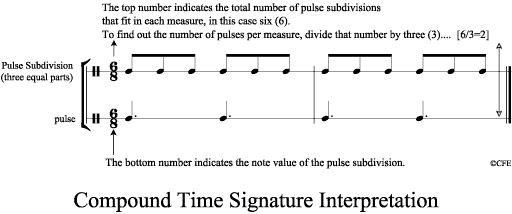
The idea that six-eight meter has six beats is a common misconception. In practice, the six eighth notes that represent the division of the beat move much too quickly to be perceived as separate beats. They are typically perceived as being grouped in two sets of three eighth notes each, suggesting two beats in each measure. That is why music in six-eight feels like duple meter.
Like simple meter, compound meter can be duple (two beats per measure), triple (three beats per measure), or quadruple (four beats per measure). We will now look at each of these meter types in turn. Keep in mind that in compound meter (a) each beat is divided into three, not two equal parts, and (b) the value of each beat is a dotted note.