
Learning Objectives
- Define the dominant seventh chord as a major triad built on the dominant of the scale with an added minor seventh above the root.
- Examine how to resolve the dominant seventh chord.
Sevenths I: The Dominant Seventh Chord
Seventh Chords
Now that you have a good understanding of triadic harmony, we are going to expand your harmonic vocabulary a bit with the addition of seventh chords. A seventh chord is produced by stacking another third on top of a triad. It is called a seventh chord because of the interval of a seventh from the root to the top note of the stack. The four notes in a seventh chord are called the root, the third, the fifth, and the seventh. Like triads, seventh chords can be built on any note of a major or minor scale. Here, for example, are the diatonic seventh chords in the key of C major:

Of these diatonic seventh chords, the seventh built on the dominant (scale degree five) is by far the most commonly found in music literature. In this lesson we will focus on the dominant seventh chord. In the following lessson, we will discuss the other types of diatonic seventh chords.
The Dominant Seventh Chord
A dominant seventh chord is the type of seventh chord that occurs naturally over the dominant scale degree (5) in a major scale. Dominant seventh chords are also known as major-minor seventh chords, because they consist of a major triad and a minor seventh, as illustrated in the following example (click "Show Me"):
Dominant Seventh Chord
Here, GBD is a major triad—the dominant in the key of C major. A minor seventh above the root G is F natural. Adding this minor seventh creates a dominant seventh chord, which has more harmonic tension than a dominant triad alone. Click on "Major Triad" in the example above to listen to the G major triad by itself. Then click "m7" to hear the added tension that the minor seventh brings to the chord.
| Remember |
|
You can also think of the dominant seventh chord (or major-minor seventh) as a major triad with a minor third stacked on top. Both approaches will provide the same result. The dominant seventh chord is labeled using a capital letter for the root of the chord, followed by the number 7: G7, F7, A7, etc.
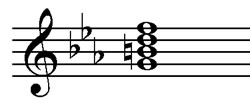
Note that in minor keys the leading tone must be raised to create a dominant seventh chord. Consider, for example, the dominant seventh in the key of C minor, shown below. Without the raised leading tone (B-natural) the dominant triad would be minor (G B♭ D). With the leading tone raised we have a major triad and a minor seventh (G-B-D-F). Essentially, it is the same chord that occurs naturally in C major.
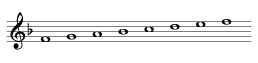
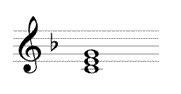
Now let's look at some dominant seventh chords in keys other than C. Remember that the term dominant seventh indicates that the chord is built on the dominant of a given key. Thus, the root of a dominant seventh in the key of F major would not be an F—it would be a C, since C is scale degree 5 in F major. As illustrated below, the V7 chord in F major is a C major-minor seventh chord, extending the dominant V chord (C-E-G) with an additional B♭. (Listen to these two chords below.)
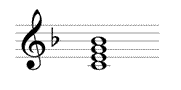
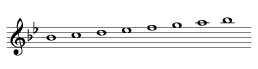
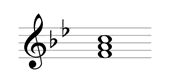
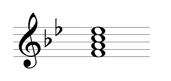
If you had a dominant seventh chord whose root was an F, what key would it be a V7 in? The pitch F is scale degree 5 in the key of B-flat major, so F7 would be the V7 in B-flat major, as illustrated in the second example below.
Resolution of the Dominant Seventh Chord
The dominant seventh chord is a dramatically tense chord that requires resolution. Part of the reason for this harmonic tension is the intervals that the chord contains. The example below shows all of the intervals that make up the dominant seventh chord. Click on the interval names below the staff. Can you hear which intervals are dissonant and which are consonant?
Minor Seventh
| Intervals in the dominant seventh chord |
There are two intervals in the dominant seventh chord that contribute most to the harmonic tension: the minor seventh between the root and the top note (here, G and F), and the diminished fifth (or tritone) between the third and the seventh (here, B and F). These dissonant intervals require resolution to consonance. Let's look at some typical resolutions of these dissonant intervals. Click on the interval names in the example below to hear how these dissonances might resolve.
Resolution of dissonance in the dominant seventh chord
In the first three cases, we see that the seventh of the V7 chord (the F) always resolves downward by step (moving down to E) to create consonant intervals. In the fourth case, the interval of a seventh (G-F) is inverted as a second (F-G), but the seventh of the chord (F) still revolves down, creating a consonant third. The last two cases demonstrate how diminished fifths usually contract to the nearest consonance (B-F to C-E) while augmented fourths usually expand to the nearest consonance (F-B to E-C). In both cases, the leading-tone (B) resolves up by step to the tonic, while the seventh (F) resolves down. Thus we can draw two conclusions about how dominant sevenths typically resolve:
| Remember |
|
This can be summarized as the following rule of thumb: "sevenths down, leading-tones up." Notice as well in the example above that in all but one case, the intervals of the dominant seventh resolve to notes of the tonic I chord (C-E-G). The most satisfying resolution of the V7 chord is to the root position I chord, as illustrated below. Click on the speaker to hear it played.
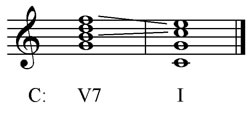
The lines in this example illustrate how the seventh (F) resolves down and the leading tone (B) resolves up as the V7 moves to I in C major.