
Overview
Despite their apparent stylistic diversity, different jazz pieces share common elements, such as improvisation and swing feeling, and on a more basic level, common forms and instrumentation. This section’s focus on form and timbre in jazz will hopefully give you a deeper understanding of jazz improvisation. To fully appreciate jazz improvisation, you should be familiar with the standard jazz forms, the sound of various instruments and their role in an ensemble—whether a musician is playing written parts or improvising.
This section also looks at the various cultures that contributed to the early development of jazz’s distinctive style and flavor. Learning where and how jazz was first created will help you understand it better.
Objectives
Upon completion of this part of the lesson, you will be able to do the following:
- Recognize the standard forms of jazz.
- Understand the roles of the various jazz instruments.
- Identify the sounds of these instruments.
- Identify the cultural origins of jazz.
- Identify the musical contribution of brass bands to jazz.
- Identify the significance of ragtime music.
- Identify the blues as a musical style.
- Identify some call-and-response genres that predate jazz.
- Identify New Orleans as a fertile culture that “birthed” jazz.
Ragtime
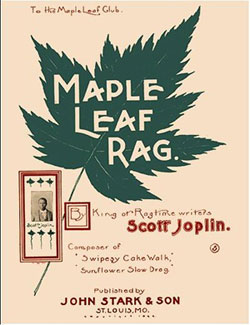
Ragtime piano had come out of Missouri around the turn of the century and swept the country. Its greatest composer was Scott Joplin (ca. 1867 — 1917). Joplin was a champion of African-American music, an accomplished composer beyond the rag idiom that he helped define. He spent his later years struggling to bring to the stage his magnum opus, Treemonisha ♫, a full-scale opera that only received recognition and its first complete performance in the 1970s, long after Joplin had succumbed to the final stages of syphilis. Joplin received posthumously a Pulitzer Prize for his contribution to American music.
Ragtime A style of American music popular around the turn of the century that featured syncopated rhythms. shared much in common with the marches of brass bands. Both tended to be in duple meter, with a bass note emphasizing each beat and a chord sounding between each bass note. We sometimes characterize this sound as "um-pah, um-pah."
What distinguished the rag were the syncopations that repeatedly filled the melody above the steady duple background. And, as we'll hear in the lesson on early jazz, the piano style of ragtime would have a great influence on early jazz stride pianoA style of jazz piano derived from ragtime in which the left hand alternates between bass notes and chords on successive beats of 4/4 time, creating an “um-pah, um-pah” foundation underneath the right hand’s melodic embellishments and improvisations. .
Listen now to another of Scott Joplin's well-known pieces, Maple Leaf Rag ♫.



During the colonial period in North America, slaves' music-centered worship and gatherings were often banned for being too "idolotrous and wild" and had to be conducted in secret.
