
Overview
The history of jazz rightly begins in the city of New Orleans. In this section, we will learn about great New Orleans jazz musicians and their early recordings in Chicago. In the process, will also learn about the emerging Chicago jazz scene and some of the artists from that area who helped develop early jazz musical styles. Finally, we will do a short overview of early jazz in New York.
Objectives
Upon completion of this lesson, you will be able to do the following:
- Define collective improvisation
- Identify early jazz musicians and their contribution to jazz music
- Appreciate the significance of Dixieland jazz
- Recognize the impact Chicago had for musicians of early jazz
- Recognize the growing importance of New York for further developments in jazz
- Define chord substitutions
Bix Beiderbecke
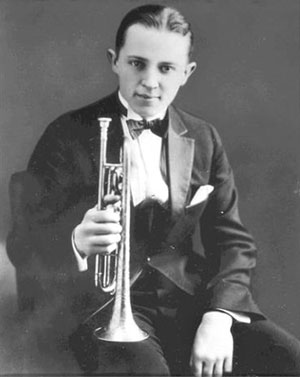
Leon "Bix" Beiderbecke (1903-1931) is considered the first great white jazz performer. As a youngster, Bix studied piano, but he soon made the switch to cornet. Growing up in Davenport, Iowa, Beiderbecke's earliest exposure to jazz came from phonograph records. The allure of the music — and the lifestyle of jazz musicians — drew Bix to Chicago, even before he could graduate from the military high school near Chicago where his parents had sent him. The tragic brevity of his life is the stuff of legends. His career as a musician would take him in fairly short order from Chicago to St. Louis to New York, where he would eventually drink himself to death at age 28.
Largely self-taught on the cornet, Beiderbecke developed a unique set of fingerings that imbued his horn with a distinctive timbre.Never a good sight-reader, he had a superb ear and a keen appreciation for modern classical music, especially the French Impressionism of Debussy and Ravel, as well as the Russian modernism of Stravinsky6.
Bix was not widely appreciated during his lifetime, except among his fellow musicians. Many jazz listeners have since come to relish his cornet improvisations and compositional genius. He is considered one of the first improvisers to pay close attention to the chord changes. His style of playing was quite different from the flashy, extroverted approach of Louis Armstrong. Beiderbecke was also not interested in the mute and plunger effects popularized by King Oliver and other New Orleans jazz barrelhouse cornetists. Instead, with an open bell — like his idol, Armstrong — Beiderbecke created his own style. His solos include long, lyrical passages, with occasional "hot" bursts. There is an introspective quality to his music, his fluid melodies seeming at times almost to "float" above the accompaniment7.
Composer and pianist Hoagy Carmichael, one of Bix's closest friends, offers this assessment:
" Bix's breaks were not as wild as Armstrong's, but they were hot and he selected each note with musical care. He showed me that jazz could be musical and beautiful as well as hot. He showed me that tempo doesn't mean fast. His music affected me in a different way. Can't tell you how — like licorice, you have to eat some8.
Most of Bix Beiderbecke's great jazz recordings were the result of his collaboration with saxophonist Frankie Trumbauer, as we'll soon hear. But there was another side to Bix's artistry, his solo piano compositions. His best known, In a Mist ♫, is the only one the composer performed himself in the recording studio.
In it, we clearly hear Beiderbecke's Midwestern ties to ragtime, even as it reveals the influence of French Impressionism. The piece gives us a deeper appreciation of the rich harmonic language that informed his cornet improvisations in his ensemble performances.



Alicia Keys covered Fats Waller's "Ain't Misbehavin'" for the 2013 movie The Great Gatsby, starring Leonardo DiCaprio and Carey Mulligan.
