
Overview
In the evolution of jazz, the New Orleans and Chicago styles of the 1920s gave way to the emerging swing style of the 1930s. In this, and the next several sections, we will learn about some of the most influential jazz musicians of this era and how their musical contributions helped shape the jazz style known as swing.
Objectives
Upon completion of this lesson, you will be able to do the following:
- Identify selected swing musicians and their contributions to jazz
- Define charts
- Identify the significance of call-and-response in Fletcher Henderson's compositions, as well as in others‘
- Define antiphonal counterpoint
Bubber Miley and "Tricky Sam" Nanton
Duke Ellington composed in a variety of styles and genres, and he was remarkably prolific. He did not like to be limited by the term "jazz composer," and the breadth of his creativity supports him on this point. Nevertheless, Duke Ellington is best known for the many swing tunes that he wrote and performed with his orchestra, not a few of which were the products of collaborations with his sidemen.
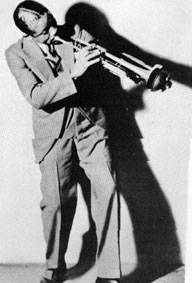
The distinctive playing styles of Ellington's sidemen distinguished his orchestra from all others. Bubber Miley (1903-1932) was the band's first star trumpeter, and he developed a growl styleA style of trumpet and trombone playing that utilizes mute and plunger effects to impart a rough, guttural vocal quality to the brass instrument. of playing that lent the trumpet a more vocal quality. The gutbucket cornet style of King Oliver strongly influenced Miley, but he was able to advance that style by combining the use of both the plunger mute and straight mute to create a "wa-wa" sound and a more controlled growl11.
Joe "Tricky Sam" Nanton (1904-1946) cultivated a similar growl style on the trombone. Ellington liked this growling brass concept so much that he wrote it into many of his compositions, and it became one of the distinctive features that contributed to the Ellington Effect.
Ellington wrote one of his early pieces, East St. Louis Toodle-Oo ♫, in collaboration with Bubber Miley and recorded it in December 1927.
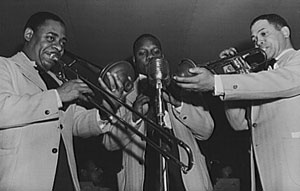
Bubber Miley is the featured soloist, but we also hear solos from a few others, including Tricky Sam Nanton on trombone (as well as Harry Carney on a most alluring clarinet). The growl style in this piece does more than contribute to the "Ellington Effect." In this case, it represents more specifically the jungle styleOne of Duke Ellington’s styles of composition and performance that employs a variety of exotic effects, often with an emphasis on driving rhythms intended to convey a “primitive” sound that was prevalent in many of Ellington's pieces during his tenure at the famous Cotton Club. The club's owners — reputedly gangsters — wanted Ellington's orchestra to evoke an exotic, "primitive" sound for their whites-only audiences, and the growl style of Miley and Nanton fit the bill.
Duke Ellington and His Orchestra, East St. Louis Toodle-Oo ♫ (Bubber Miley and Duke Ellington), New York, December 19, 1927. Duke Ellington, piano; Bubber Miley, Louis Metcalf, trumpet; Joe Nanton, trombone; Otto Hardwicke, soprano sax, alto sax, and baritone sax; Harry Carney, clarinet, alto sax, and baritone sax; Rudy Jackson, clarinet and tenor sax; Fred Guy, banjo; Wellman Braud, bass; Sonny Greer, drums.



Billy Strayhorn's last composition was "Blood Count" (originally titled "Blue Cloud"), written during his battle with cancer. Duke Ellington debuted it at a concert in Carnegie Hall in March 1967 and never played it publicly again.
