
Overview
Chicago jazz musicians continued to gravitate to New York, owing largely to the sheer magnitude of the Big Apple and the opportunities it presented. In this lesson, we will learn more about important musicians, their performing talents, and members of the orchestras they established.
In the 1920s and 1930s, Chicago and New York were not the only cities where jazz was emerging and evolving. Its rapid spread meant that nearly every metropolitan area in the United States had its own burgeoning jazz scene.
There were, however, a few cities where jazz was particularly nurtured and performance opportunities were more abundant than in others. In this section we will see how Kansas City was one of those cities, possibly the only one that could rival New York and Chicago in the early 1930s, and look at the early careers of Count Basie, Duke Ellington, and Mary Lou Williams, three musicians who displayed enormous gifts as instrumentalists, bandleaders, composers, and arrangers.
Objectives
Upon completion of this lesson, you will be able to do the following:
- Appreciate Benny Goodman’s contribution to the popularization of swing music in America
- Recognize Kansas City's importance as a center for jazz during the swing era
- Identify musicians associated with Count Basie and their contributions to jazz
- Identify Count Basie's use of call and response in his band's arrangements
- Define riff
- Define head arrangement
- Recognize the contributions to jazz of Mary Lou Williams
- Recognize the contributions of Billie Holiday and Ella Fitzgerald to vocal jazz and popular song
Ella Fitzgerald
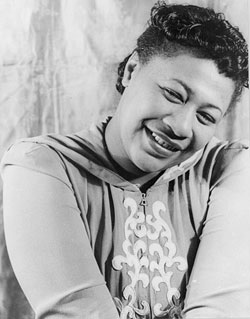
A marked contrast to the poignant, emotional sensitivity of Billie Holiday is the lighter, more carefree style of Ella Fitzgerald (1917-1996). Ella was gifted with a wide vocal range and superb intonation (that is, pitch). For fans of Ella, her exuberance is real — and contagious — as is her ability to swing. She ranks, along with Louis Armstrong, as one of the greatest scat singers in the history of jazz.
Ella Fitzgerald also got her start singing in Harlem. In 1934 she won an amateur contest at the Apollo Theatre at age 17, and the following year she began singing with the Chick Webb Orchestra. Ella and Webb's orchestra had their first big hit in 1938 with A-Tisket A-Tasket ♫.
When Webb died from spinal tuberculosis in 1939, Fitzgerald took over leadership of the band until it disbanded in 1942. She launched her solo career and achieved great popular and artistic success. Her long collaborative association with producer Norman Granz proved especially fruitful in that regard.
Let's listen to Ella Fitzgerald recorded live in 1964 at an open-air jazz festival in France, singing the Cole Porter tune You'd Be So Nice To Come Home To ♫. Ella is in top form, as she stays close to the melody through the first chorus, and then solos dynamically through the remainder of the piece. In many respects, Ella Fitzgerald represents the epitome of jazz vocal improvisation. Arguably, only Louis Armstrong could match her vocal melodic invention. On this recording, Ella is accompanied by a quartet of excellent jazz musicians that includes Roy Eldridge on muted trumpet and Tommy Flanagan on piano.



During a radio broadcast performance of The Barons of Rhythm at The Reno Club, an announcer looking to introduce William Basie with an unique name, gave him the name "Count" Basie.
