
Overview
Chicago jazz musicians continued to gravitate to New York, owing largely to the sheer magnitude of the Big Apple and the opportunities it presented. In this lesson, we will learn more about important musicians, their performing talents, and members of the orchestras they established.
In the 1920s and 1930s, Chicago and New York were not the only cities where jazz was emerging and evolving. Its rapid spread meant that nearly every metropolitan area in the United States had its own burgeoning jazz scene.
There were, however, a few cities where jazz was particularly nurtured and performance opportunities were more abundant than in others. In this section we will see how Kansas City was one of those cities, possibly the only one that could rival New York and Chicago in the early 1930s, and look at the early careers of Count Basie, Duke Ellington, and Mary Lou Williams, three musicians who displayed enormous gifts as instrumentalists, bandleaders, composers, and arrangers.
Objectives
Upon completion of this lesson, you will be able to do the following:
- Appreciate Benny Goodman’s contribution to the popularization of swing music in America
- Recognize Kansas City's importance as a center for jazz during the swing era
- Identify musicians associated with Count Basie and their contributions to jazz
- Identify Count Basie's use of call and response in his band's arrangements
- Define riff
- Define head arrangement
- Recognize the contributions to jazz of Mary Lou Williams
- Recognize the contributions of Billie Holiday and Ella Fitzgerald to vocal jazz and popular song
The Savoy Ballroom and Chick Webb
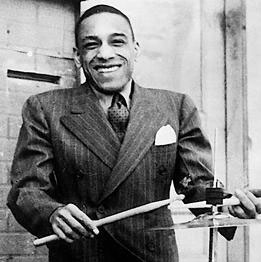
One of the most important venues for big band swing was the Savoy Ballroom in Harlem. The Savoy Ballroom featured some of the top big bands from the late 1920s to the 1950s. The Savoy's most famous house band was led by hard-swinging drummer Chick Webb (1909-1939). Chick Webb and his Orchestra performed for integrated dancers at the Savoy in the late 1920s and 1930s7. His band proved to be one most swinging bands in the country and attracted some of the greatest swing dancers in New York, both black and white.
The Savoy Ballroom was enormous and had enough room to feature two big bands. In the 1930s Chick Webb invited rival big bands to participate in "cutting contests," and two of these "cutting contests" turned out to be particularly historic. In 1937, the Benny Goodman Orchestra was "cut" by the heavy swinging Webb in front of a capacity crowd at the Savoy. Goodman may have been out-swung that evening, but this was an event of great social significance because a black orchestra and a white orchestra performed together in front of an integrated audience8.
The second historic "cutting contest" at the Savoy occurred on January 16, 1938, an evening marked by an extraordinary coincidence of historic jazz performances and the convergence of some of jazz's greatest musicians. Earlier in the evening, Benny Goodman had performed at Carnegie Hall; jazz was finally receiving its due from that great bastion of serious art music3. Equally important, the concert featured an integrated ensemble: Goodman and members of his band performing with Count Basie, members of his band, and members of Duke Ellington's band.
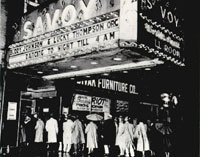
Count Basie and his band left the Carnegie Hall concert early to participate in a "cutting contest" with Chick Webb at the Savoy later that evening, a battle of the two greatest swing bands. Many of those in attendance claimed it was a tie — out of respect for Webb. However, Basie and his Kansas City sound proved to be the most swinging band in the land4.



In 1985, Count Basie was posthumously awarded the Presidential Medal of Freedom by Ronald Reagan.
