
Overview
In the early 1940s, a number of innovative and daring jazz musicians began searching for a new style. In after-hours jam sessions, they experimented with new melodic and harmonic vocabularies that challenged listeners and musicians alike. This music would come to be known by its onomatopoeic description: bebop.
In this section, we will first focus on the two principal innovators of this new jazz style: Charlie Parker and Dizzy Gillespie. We will also discover how the swing-style jazz of Count Basie provided a basis for the transition to bebop and the advent of the modern jazz era. In the second half of the section, we will discover other influential musicians who helped shape bebop and modern jazz.
Objectives
Upon completion of this lesson, you will be able to do the following:
- Identify Charlie Parker and Dizzy Gillespie as the principal innovators who contributed to the development of bebop
- Appreciate bebop as a new approach that ushered in modern jazz
Thelonious Monk
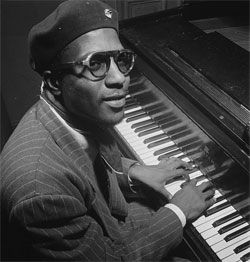
Pianist and composer Thelonious Monk (1917-1982) was an original, considered by many one of the giants of jazz. Born in North Carolina, Monk moved with his family at age 4 to New York City, where he grew up during the early years of jazz. The stride style of James P. Johnson was an early influence, as were the styles of Fats Waller (Ain't Misbehavin' ♫), Art Tatum, and Duke Ellington; but Monk developed a style of piano playing all his own.
There is a "spikiness" to Monk's harmonies and melodies that often strikes new listeners as mistakes in his playing. (But of course, they're not mistakes.)
Jazz had been evolving toward more dissonance when Monk entered the scene, but his concepts of harmony and melody were advanced beyond even bop idioms.
During the years of Bud Powell's ascendance in the late 40s, Monk was largely dismissed — even within knowledgeable jazz circles. He could not match Powell's speed or touch, and many considered him "stuck" in his own peculiar ways. With the passing of a decade, those peculiar ways of Monk's came to be viewed as compositional genius.



Dizzy Gillespie played his trumpet with the bell turned upwards at a 45-degree angle. Gillespie discovered he liked the sound that it created after someone fell on his trumpet stand causing the bell to bend.
