
Overview
The history and evolution of jazz—and the world inhabited by its innovators and practitioners—continues to provide a remarkable lens through which to view the larger American cultural landscape. The early 1950s United States was still a racially segregated society, especially in the South. And while the "color line" in jazz had been crossed more than a decade earlier, the terms of such interactions continued to be dictated by the dominant white culture.
In this section we will see how hard bop represents the maturation of bebop—its evolution, and how Charlie Bird and Dizzy Gillespie threw the doors open (or "blown" them open), ushering in not just a new style, but a new era—the modern jazz era.
Racial dynamics were also at play at the advent of hard bop. It's worth noting that many of the innovators of cool jazz were white, with the notable exception of Miles Davis and John Lewis. We will explore how emerging hard bop styles were motivated in part by black jazz musicians' desire to reclaim jazz as their own music.
Objectives
Upon completion of this lesson, you will be able to do the following:
- Identify musicians who created jazz that came to be known as hard bop
- Identify similarities and differences between bop and hard bop
Art Blakey
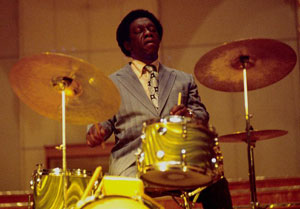
Drummer Art Blakey and pianist Horace Silver formed the Jazz Messengers (It's Only A Paper Moon ♫), one of the earliest hard bop collaborations and arguably the definitive hard bop group.
Art Blakey (1919-1990) was a dynamic hard bop drummer and bandleader. He developed the hard bop tendencies of drumming loudly and with greater activity. He also nurtured young jazz talent in his band for more than three decades.
Blakey grew up in Pittsburgh and began playing piano for his church at an early age. He made the switch from piano to drums when the owner of the Pittsburgh nightclub where he was gigging insisted that Blakey make way on the spot for another young pianist, Erroll Garner. Blakey then began serious study of the drums, taking swing drummers Sid Catlett and Chick Webb as his early models. By 1937, Blakey was performing with pianist Mary Lou Williams. He left Pittsburgh in 1939 to tour with Fletcher Henderson's orchestra for three years. Soon afterward, Blakey joined Billy Eckstine's bop big band, playing with such other jazz luminaries as Charlie Parker, Dizzy Gillespie, and Sarah Vaughn.
In February 1954, Blakey put together a quintet consisting of Clifford Brown on trumpet, Lou Donaldson on alto sax, Horace Silver on piano, and Curly Russell on bass. Their show at the jazz club Birdland in New York City on the evening of February 21 proved to be a landmark in hard bop performance, as well as in jazz recording. At the time, the long-playing record (LP) was a relatively new innovation, and the recording of the February 21, 1954 Birdland show was among the first to take advantage of the technology's ability to record and press more than three-and-a-half minutes on a track—a significant breakthrough with profound implications for jazz performance.
Lou Donaldson on alto sax was robust and bluesy. Curly Russell on bass was superb. But the stars of the show were Art Blakey, Horace Silver, and Clifford Brown. Blakey was the bandleader, the seasoned veteran. Silver was already established as a pianist and composer. And Clifford Brown was "the new trumpet sensation," in the words of Pee Wee Marquette, who introduced the band that evening.
Let's listen to the band's opening number, a tune composed by Horace Silver, Split Kick ♫. It's a 32-bar binary form (ABAB') that follows a rousing 8-bar introduction (0:00-0:09). The tune itself (0:10-0:44) is lively and bright. The segue from the end of the first chorus to the beginning of the second is handled cleverly by alto saxophonist Lou Donaldson. He carries forward the concluding notes of the melody as a motif to begin his bluesy solo, which extends over three choruses (0:44-2:30). Clifford Brown then takes center stage, soloing over the next four choruses (2:30-4:48). True to his billing, Brown is sensational. His rich, fat tone — which extends into the upper register — coupled with lyricism, virtuosic technique, and a wealth of ideas, is simply dazzling. A noteworthy solo follows by Horace Silver (4:48-6:29), which includes an extended development of a quotation (6:01-6:04) from a classical composition, Edvard Grieg's "In the Hall of the Mountain King." And Art Blakey solos for 36 bars (7:03-7:40) before the band returns to the head to close.



"Jimmy Smith's father was a musician and entertainer, and young Jimmy joined his song-and-dance act when he was six years old."
