Overview
In this section, we will focus on the late 1950s and early 1960s to learn more about Miles Davis and two of his most influential sidemen: Bill Evans and John Coltrane. We will consider the significance of Davis' musical compositions and those of his fellow musicians, and examine how their works continue to impact jazz even to the present day.
Objectives
Upon completion of this lesson, you will be able to do the following:
- Identify many of the contributions of Miles Davis to jazz
- Define modal jazz
- Recognize the contributions of Bill Evans to jazz—most especially to jazz piano
- Recognize the contributions of the members of Bill Evans’ most celebrated trio
- Recognize the contributions of John Coltrane as saxophonist, composer and bandleader
- Recognize the contributions of the members of John Coltrane’s classic quartet
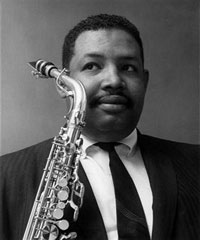
Miles Davis Sextet, 1959
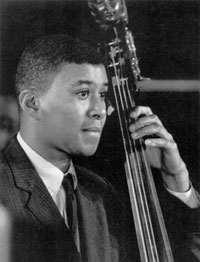
The spring of 1958 witnessed the departure of Red Garland and Philly Joe Jones from the Davis sextet. Replacing them in the rhythm sectionThe section of a jazz combo consisting of piano, guitar, double bass, and drums. were Jimmy Cobb (b. 1929) on drums and Bill Evans on piano.
Bill Evans (1929-1980) is widely regarded as one of the most influential pianists of the modern jazz era. He had an impeccable touch that was marvelously fluid. Evans developed a style that owed as much to the influence of the French Impressionists Claude Debussy (Clare de Lune, L. 32 ♫) and Maurice Ravel (String Quartet in F Major: II. Assez vif - Tres rythme ♫) as it did such notable jazz pianists as Bud Powell (Bouncin' with Bud ♫) and Lennie Tristano (All The Things You Are ♫).
Evans explored new chord voicingsA term referring to the particular arrangement of the notes in a chord. that further explored the 9ths, 11ths, and 13ths of jazz harmonies, and he developed solo lines that reflected similar melodic complexity. Despite his remarkable virtuosity, Evans' style mirrored Davis' in his striving to say more with less. He also had a similar tendency in his solos to "float" over the beat.
This reconstituted sextet — Miles Davis, John Coltrane, Cannonball Adderley, Bill Evans, Paul Chambers and Jimmy Cobb — would play together for only a year (Evans, Coltrane, and Adderley would depart to lead their own bands). But their time together would culminate in the landmark 1959 recording Kind of Blue1.