
Overview
In this section, we will focus on the late 1950s and early 1960s to learn more about Miles Davis and two of his most influential sidemen: Bill Evans and John Coltrane. We will consider the significance of Davis' musical compositions and those of his fellow musicians, and examine how their works continue to impact jazz even to the present day.
Objectives
Upon completion of this lesson, you will be able to do the following:
- Identify many of the contributions of Miles Davis to jazz
- Define modal jazz
- Recognize the contributions of Bill Evans to jazz—most especially to jazz piano
- Recognize the contributions of the members of Bill Evans’ most celebrated trio
- Recognize the contributions of John Coltrane as saxophonist, composer and bandleader
- Recognize the contributions of the members of John Coltrane’s classic quartet
John Coltrane
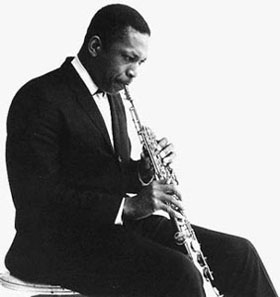
John Coltrane (1926-1967) emerged as a leading tenor voice in the mid-to-late 1950s on the basis of his sideman duties with Thelonious Monk and Miles Davis. In 1959, at the same time that he was recording with Davis on Kind of Blue ♫, his own career as a bandleader was already taking off.
Born in North Carolina, and coming of age musically in Philadelphia, John Coltrane was a seeker of knowledge throughout his life. Even though his career in the limelight lasted barely more than ten years, he became one of the most influential jazz musicians of the last 50 years. He continues to inspire musicians of all instruments, as well as authors, poets, and painters.
Coltrane expanded the possibilities of the saxophone for the jazz player. An avid reader, he devoured Nicolas Slonimsky's Thesaurus of Scales and Melodic Patterns and made it part of his improvisational vocabulary. He executed torrents of notes that jazz critic Ira Gitler famously described as "sheets of sound." The power and technique he possessed have not been surpassed since his death, and his laser-like biting tone is still emulated. He revitalized the soprano saxophone and expanded the playing range of the saxophone by utilizing the altissimo (high register). He was among the first to introduce on saxophone the use of multiphonicsAn instrumental technique in which two or more tones are produced simultaneously from an instrument designed to play only one tone at a time.; that is, playing more than one note at a time. In addition to all this, Coltrane was also a prolific composer for his group.



The Village Vanguard is one of New York's celebrated jazz rooms, opened in 1935 by Max Gordon
