
Overview
Amidst a politically tumultuous world, a new style of jazz broke away from the constraints of mainstream modern jazz. Known as free jazz, this new style formed the core of the avant-garde movement in jazz. In this section, we will examine some influential avant-garde and free jazz musicians, and the artistic and cultural significance of their music. In addition, we'll consider the music of Miles Davis' mid-60s quintet, along with the significant individual contributions of the quintet’s pianist, Herbie Hancock.
Objectives
Upon completion of this lesson, you will be able to do the following:
- Identify musicians who contributed to avant-garde and free jazz styles
- Appreciate Ornette Coleman’s unique use of pitch bending
- Appreciate the Miles Davis mid-60s quintet as another innovative jazz group led by Davis
- Recognize the accomplishments of Herbie Hancock during that time
- Identify musicians who collaborated with Herbie Hancock
Ascension
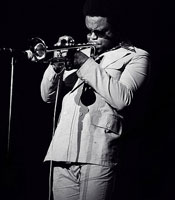
John Coltrane, whom we studied earlier, embraced free jazz during the last few years of his life. In his 1965 recording "Ascension," he employed collective improvisationA characteristic feature of New Orleans jazz in which multiple instrumentalists improvise together according to agreed-upon conventions. within his group and multiphonicsAn instrumental technique in which two or more tones are produced simultaneously from an instrument designed to play only one tone at a time. in his own playing, both techniques closely associated with the free jazz movement. He also augmented his quartet by adding a second bass player and six horn players. The result is a very dense and dissonant sounding free jazz performance that runs continuously for 40 minutes (as nearly did Free Jazz ♫), alternating between ensemble passages of collective improvisation and individual solos.
In this 10-minute excerpt from "Ascension," we hear the opening ensemble passage, then Coltrane's solo, followed by the beginning of the next ensemble passage of collective improvisation. Coltrane brought in some notable sidemen to augment his group, including Freddie Hubbard (1938-2008) on trumpet and Archie Shepp (b. 1937) and Pharoah Sanders (b. 1940) on tenor sax. These latter two players went on to establish themselves as leaders in the free jazz movement, and each has a strong solo in "Ascension." In this excerpt, we'll hear Coltrane's solo, which is classic avant-garde Coltrane — the last phase of his musical development. Note his expressive use of the entire range of his instrument. See if you can pick out the occasional references to the theme from A Love Supreme that we previously heard in Acknowledgement ♫, coming from both Coltrane and the ensemble. Click the play button in the embedded video link below to listen.
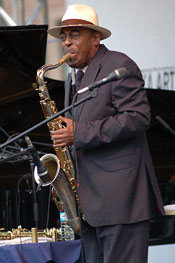



Ornette Coleman taught himself to first play Alto saxophone, then tenor saxaphone as a teenager. In the 1960's, Coleman taught himself to play the violin and trumpet.
