
Overview
This section examines how Miles Davis became a driving force in the effort to combine jazz and rock music to form a new style of jazz known variously as jazz fusion, jazz-rock fusion, or simply fusion. We will focus particularly on Davis’ seminal 1969 album, Bitches Brew.
A number of the musicians who worked with Miles Davis in forging the new fusion style of jazz eventually formed their own bands. We will consider the work of Miles Davis’ sidemen as leaders in their own fusion bands, particularly Wayne Shorter, Joe Zawinul, John McLaughlin, and Herbie Hancock. We will also look at other artists who explored various currents in jazz-rock fusion.
Finally, having already examined Bill Evans and Herbie Hancock in some detail, we'll take a closer look at two more trend-setting Miles Davis keyboardists, Chick Corea and Keith Jarrett, and their work as pioneers in acoustic settings.
Objectives
Upon completion of this lesson, you will be able to do the following:
- Identify influential jazz-rock fusion musicians and their contributions
- Appreciate the accomplishments of Chick Corea and Keith Jarrett
- Identify musicians who collaborated with Chick Corea and Keith Jarrett
Return to Forever
After his work with Miles Davis in the late 1960s, Chick Corea pursued a number of avant-garde projects, notably his collaboration with saxophonist Anthony Braxton in the formation of the band Circle. Seeking a larger audience, Corea returned to jazz-rock fusion in 1971, founding the band Return to Forever (Dayride ♫).
Return to Forever's bassist, Stanley Clarke (b. 1951) (All Blues - Live ♫), arrived in New York from the Philadelphia Academy of Music in 1971 and was quickly recognized as a virtuoso on both acoustic double bass and electric bass. He performed with such jazz notables as Horace Silver, Art Blakey, and Stan Getz before joining Corea's band. Even before Jaco Pastorius' arrival on the scene, Stanley Clarke demonstrated the melodic potential of the electric bass guitar in jazz-rock fusion.
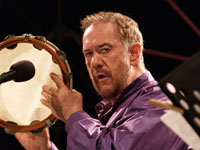
Return to Forever's first incarnation also included Brazilian drummer and percussionist Airto Moreira (b. 1941) (Escape ♫), who had participated in some of the Bitches Brew sessions with Corea as well as on the Davis follow-up projects Live-Evil ♫ and Live at the Fillmore East ♫. Moreira also recorded with Weather Report on the band's inaugural album in 1971 before leaving to join Return to Forever.
Airto Moreira's wife, Brazilian jazz singer Flora Purim (Light As A Feather ♫), was another original member of Return to Forever, as was tenor saxophonist and flutist Joe Farrell (1937-1986). The group's second album, Light As a Feather, includes some of Return to Forever's most notable and popular performances, including Corea's Grammy-nominated Spain ♫.
The subdued introduction (0:00-1:14) is an interpretation of the Adagio movement from Spanish composer Joaquin Rodrigo's Concierto de Aranjuez (which also famously served as the basis for Miles Davis' 1960 collaboration with Gil Evans, Sketches of Spain). The chorus that follows is a marked contrast in tempo and spirit — a very catchy samba-like tune with two principal sections. The first 12-bar section has a smooth melodic line played by flute and keyboard and reinforced by Flora Purim's vocals (1:20-1:31). The second section is even more exuberant, characterized by hand clapping and lively staccato melodic figures (1:31-1:47). We hear solos from Joe Farrell on flute (2:48-4:34), Chick Corea on electric piano (5:10-6:57), and Stanley Clarke on bass (7:34-8:34).



The sight and sound of turntable scratching was made popular after Grandmaster D.St scratched while Herbie Hancock played the clavitar during a performance of "Rockit" at the 1984, 26th Grammy Awards show.
