
Overview
While history is inherently polemic, recent jazz history is even more so, because it lacks a linear stylistic evolution and, as such, departs from characteristic developments in jazz during the first 75 years of its existence.
It’s no surprise then, that the decades since 1980 have been the most diverse and controversial in the history of jazz. Over this time, there has been a proliferation of artistic approaches and a host of superb musicians that made them happen, keeping in mind that it is difficult, if not impossible, to single out a single towering figure in jazz among Morton, Armstrong, Ellington, Parker, Gillespie, Monk, Davis, Coltrane, and, some would argue, Mingus, Coleman, and Ayler.
In this section we will focus on those artists who came to prominence in the late 1970s and 1980s. Admittedly, the grouping of these musicians is somewhat arbitrary, given the lengthy careers many of them enjoyed. Accepting, then, that no survey of the past three decades can be completely satisfying, we offer these artists as among those deserving of our attention.
Objectives
Upon completion of this lesson, you will be able to do the following:
- Appreciate postmodernism as it relates to jazz
- Appreciate neo-classicism as it relates to jazz
- Identify leading postmodern and neo-classical musicians and their contributions to jazz
Postmodernism in Jazz
Broadly speaking, postmodernismA late-20th century movement in the arts that represents a departure from Modernism. may be viewed as a reaction against modernism Any of a number of movements in arts and literature, arising in the late 19th and early 20th centuries, that had in common a rejection of traditional forms, including movements such as Surrealism, Symbolism, Futurism, Expressionism, Cubism, and more. in the arts. Three fundamental principles of postmodernism are:
- Postmodernism abandons the modernist ideal of originality; instead it openly relies on citation and allusion;
- Postmodernism embraces all artistic styles, including the popular arts; this is in contrast to the highbrow tendencies and seriousness of modernism;
- Expression and emotional appeal are important goals of art1.
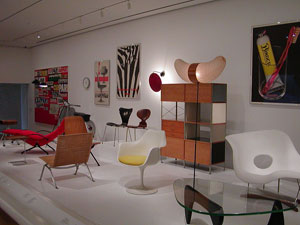
Postmodernist art tends to look for the humor in a situation and not take itself too seriously. Juxtaposition of contrasting styles is not uncommon. Self-contradiction, ambiguity, absurdity, passion — these and all other conditions of the human experience do not have to "fit" into some tidy order that will help us make sense of things, according to postmodern thought. The rational mind is not the immediate evaluator of a work of art. Art is an experience. And it is the unconscious mind that "processes" that experience and determines for us the value and worth we ascribe to a work of art.
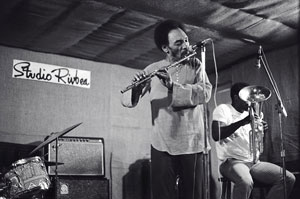
The postmodernist movement in jazz grew out of the avant-garde and free jazz movements of the 1960s. In a very real sense, postmodernism reflects the evolution of avant-garde jazz, from the first-generation "highbrow" seriousness of politically charged "freedom" jazz, to a more jaded, glib, hip, self-conscious, tongue-in-cheek approach to the art.
It should be pointed out that the term "postmodernism," as applied to jazz, has not gained wide currency. Many jazz historians continue to use the term "avant-garde" to describe this music.The term "postmodernism," though, is useful in drawing distinctions between the early avant-garde — who, in some respects, explored extremes of style to the point of sonic anarchy — and the later wave of avant-garde, who have drawn upon not only these extremes of style, but also every style of jazz that preceded the avant-garde movement.
If any one trait characterizes a postmodern style of jazz, it would be the conscious incorporation and restructuring of all previous styles of jazz. Anything, from the collective improvisation of an early New Orleans two-step to the most far-reaching, shrieking Aylerian utterances, can find its way into postmodern jazzAlso known as "avant-garde jazz", a genre of jazz music that subsumes and restructures all the previous styles of jazz. — even within the same piece!2



Before attending Julliard, Wynton Marsalis became the youngest musician admitted to Tanglewood’s Berkshire Music Center at the age of 17. There he received the schools Harvey Shapiro Award for outstanding brass student.
