
Overview
While history is inherently polemic, recent jazz history is even more so, because it lacks a linear stylistic evolution and, as such, departs from characteristic developments in jazz during the first 75 years of its existence.
It’s no surprise then, that the decades since 1980 have been the most diverse and controversial in the history of jazz. Over this time, there has been a proliferation of artistic approaches and a host of superb musicians that made them happen, keeping in mind that it is difficult, if not impossible, to single out a single towering figure in jazz among Morton, Armstrong, Ellington, Parker, Gillespie, Monk, Davis, Coltrane, and, some would argue, Mingus, Coleman, and Ayler.
In this section we will focus on those artists who came to prominence in the late 1970s and 1980s. Admittedly, the grouping of these musicians is somewhat arbitrary, given the lengthy careers many of them enjoyed. Accepting, then, that no survey of the past three decades can be completely satisfying, we offer these artists as among those deserving of our attention.
Objectives
Upon completion of this lesson, you will be able to do the following:
- Appreciate postmodernism as it relates to jazz
- Appreciate neo-classicism as it relates to jazz
- Identify leading postmodern and neo-classical musicians and their contributions to jazz
Neo-Classicism in Jazz
Neo-classical jazzA genre of jazz music that emerged in the 1980s, characterized by a return to traditional jazz instruments and the origins of jazz: blues and swing. (a.k.a. neo-traditional jazz, neo-conservative jazz) emerged in the 1980s as a reaction against the various jazz "fusions" of the 1970s. Neo-classical jazz also marked an effort to counter the influence of the progressive jazz players (a.k.a. avant-garde, postmodernists) that had gained strongholds in many American cities. It signaled a return to traditional jazz instruments and the fundamental African American elements of the art that derived from the New Orleans tradition: blues and swing.
The central figure spearheading the neo-classical movement in jazz is trumpeter-composer-bandleader Wynton Marsalis (b. 1961). A phenomenally talented prodigy, Marsalis grew up in New Orleans in a musical family. His father Ellis is a jazz pianist (who continues to perform), and three of his brothers are musicians as well.
Wynton Marsalis progressed rapidly in his youth, both as a classical and jazz trumpeter. In 1980, while a student at Julliard, he joined Art Blakey's Jazz Messengers.
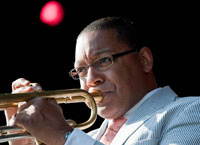
Over the next three years, he performed with other jazz notables, including Herbie Hancock, Ron Carter, and Tony Williams. By age 22, Marsalis had won Grammy awards for his recordings in both the jazz and classical categories, an unprecedented achievement.
Marsalis' combo recordings from the mid-1980s suggested he was prepared to carry forward the progressive style of the Miles Davis mid-60s quintet (albeit 20 years later). The December 1986 double-CD recording of the Wynton Marsalis Quartet, Live at Blues Alley, and the group's studio album Marsalis Standard Time, Vol. 1 ♫, recorded a few months earlier, are regarded by many as Marsalis' most intense and progressive work.
While the debt to Davis is unmistakable on these albums, Marsalis and his sidemen — Marcus Roberts on piano, Robert Hurst on bass, and Jeff "Tain" Watts on drums — probe this jazz style with forcefulness and daring. On the live album, Marsalis also demonstrates his brilliance as a composer — a facet of his musical talents that a decade later would earn him a Pulitzer Prize for his jazz orchestra work, Blood on the Fields.
Knozz-Moe-King ♫, the opening track on the 2-CD album Live at Blues Alley, is a prime example of the excellence of the quartet — and of Marsalis the composer and performer. This is some of the most progressive playing in the trumpeter's long and storied career.
Starting with the scantest of "tunes" (0:03-0:05), Wynton takes off on an improvisational tour de force (0:05-2:58) that relies on the responsiveness of all four musicians. Almost out of the gate they are in 5/4 meter, but that quickly changes. The array of meters and modes that organize this piece is variable and depends entirely on the responsive interactions of the players. This is a live performance, and they are performing "without a net." It is a testament to the excellence of all four members that they succeed in such an ambitious undertaking. The rhythm section The section of a jazz combo consisting of piano, guitar, double bass, and drums. is first-rate. During the piano solo (3:01-5:54), we are essentially treated to a legendary piano trio performance with Marcus Roberts on piano, Robert Hurst on bass, and Jeff "Tain" Watts on drums. While Marsalis and Roberts merit our attention as soloists, much of the success of this piece is owed to Hurst and Watts in the rhythm section.



Anthony Braxton spent over 40 years teaching, spending the last part of his teaching career as a professor at Wesleyan University until he retired in 2013.
