
Overview
Objectives
Upon completion of this lesson, you will be able to do the following:
- Recognize some of the key American and Cuban jazz artists and their contributions to Latin jazz
- Recognize some of the international figures in jazz who contribute to the globalization of jazz
- Recognize some of the recent jazz artists, both mainstream and progressive, whose art continues to fuel the debate about the future of jazz—and what jazz is
Branford Marsalis
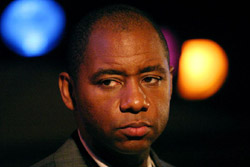
Saxophonist, composer, and bandleader Branford Marsalis (b. 1960) has enjoyed a varied and productive career since his emergence in the 1980s. Like his younger brother Wynton, Branford played in Art Blakey's Jazz Messengers before leaving to join Wynton's quintet in the mid-1980s. In the 1980s he played with such jazz notables as Miles Davis, Dizzy Gillespie, Herbie Hancock, and Sonny Rollins.
Over the last quarter-century, Branford's diverse activities have included recording and touring with Sting, a two-year stint as musical director of The Tonight Show, collaborations with the Grateful Dead and Bruce Hornsby, as well as acting roles in several films. Marsalis has also maintained a jazz quartet over much of this time.
Branford Marsalis' 1992 album I Heard You Twice the First Time stands among his highly regarded works, earning a Grammy Award that year for best jazz instrumental performance. The album, steeped in blues, features guest artists B. B. King and John Lee Hooker and demonstrates convincingly that it is a very fine line separating jazz from the blues — if such a line can even be discerned!
The opening track, Brother Trying to Catch a Cab (On the East Side) Blues ♫, is an original composition from bassist Robert Hurst (whom we heard play in Wynton's 1986 quartet). The trio, consisting of tenor sax, bass, and drums, delivers a straight-ahead performance that sounds remarkably full, despite the absence of pianist Kenny Kirkland on this number. The composition is framed by a bit of tongue-in-cheek audio theater, adding some political overtones — and undertones — that resonate across the album's conceptual arc, resurfacing on occasion in some pointed and powerful ways.
When the music begins, we hear Hurst's 12-bar blues tune played twice (0:36-0:57). Branford Marsalis then launches into an extended virtuosic solo, notable for the responsive interaction we hear among the trio, as well as for moments when Marsalis ascends to his instrument's extreme high register (ca. 3:30). Hurst follows with a bass solo that spotlights his versatility (4:32-6:05). When Branford re-enters, he begins trading choruses with drummer Jeff "Tain" Watts (6:05-6:57) until Watts uses his third turn as a springboard for his own solo (6:57-8:22). The trio returns to the headA synonym for melody. (8:22-8:45), gradually diminishing in volume through the repeat of the chorus, before the audio theater returns closes the track. Let's listen Brother Trying to Catch a Cab (On the East Side) Blues ♫.



