
Overview
Objectives
Upon completion of this lesson, you will be able to do the following:
- Recognize some of the key American and Cuban jazz artists and their contributions to Latin jazz
- Recognize some of the international figures in jazz who contribute to the globalization of jazz
- Recognize some of the recent jazz artists, both mainstream and progressive, whose art continues to fuel the debate about the future of jazz—and what jazz is
Brad Mehldau
Pianist Brad Mehldau (b. 1970) studied classical piano as a child and was drawn to jazz before high school. Winner of a competition sponsored by Berklee College of Music, Mehldau went on to study jazz at the New School in New York. He has collaborated with a host of jazz artists including Joshua Redman and, more recently, Pat Metheny.
In the mid-1990s, Mehldau began leading his own piano trio, and the trio format has since held an important place in his repertoire.
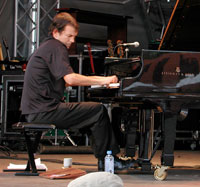
Building from the tradition of Bill Evans — and often with a similarly "meditative" aesthetic — Mehldau brings a highly imaginative approach to the acoustic piano trio, and he has expanded his trio's repertoire with original compositions. He is also known for his covers of such popular music as Radiohead's Paranoid Android ♫ and Exit Music ♫.
Mehldau has demonstrated brilliance in his interpretations of jazz standards. His trio's live performance date at the Village Vanguard in 1997 includes a performance of Thelonious Monk's Monk's Dream ♫. After a characteristically "Monk-ish" rendition of the headA synonym for melody. (0:00-0:38), Mehldau solos over the next six-plus minutes, quickly moving away from Monk's idiosyncratic vocabulary to channel a wealth of ideas springing up from within. His piano technique is stunning, and his solo builds intensity, nearing a fever pitch before his return to more familiar sounds (6:45). The trio keeps things fresh throughout, and there is some playful trading between the pianist and drummer Jorge Rossy before they return to the head (7:04-8:50). Then another surprise awaits: a coda The concluding passage of a piece of music, typically forming an extension to the basic structure. that serves as an extension of Mehldau's earlier solo (9:28-10:57). Let's listen Monk's Dream ♫.



"I Heard it Through the Grapevine" has been recorded by several different artists, including Gladys Knight and the Pips, Marvin Gaye, and Roger Troutman, who all had #1 R&B hits with their versions, making this the only song to hit #1 on R&B charts for 3 different artists.
