
Overview
Objectives
- Examine the important features of African American music, such as syncopation, swing, and tone color
- Examine the aspects that made Tin Pan Alley and Broadway songs successful, such as specific forms, sentimental lyrics, and inexpensive sheet music
- Examine the early part of the twentieth century that represented a time when listeners transitioned from consuming sheet music and playing music at home to purchasing recorded music to listen to at home.
- Examine how Tin Pan Alley rose in popularity at the turn of the 20th century
- Identify Tin Pan Alley composers
- Define vaudeville
- Define ragtime
- Discuss the features of ragtime music
- Identify various Dixieland jazz combos
Introduction
Before the advent of recording technology in the early part of the twentieth century, most people consumed popular music in one of two ways. First, they participated in oral traditions, passing down music for generations without a written version. Second, they purchased sheet music of popular songs, performing the music at home.
In oral tradition, the music is played entirely by rote or by memory, and the musicians do not use a written score. Instead of reading sheet music to learn the notes, performers absorb the music from performances. Different regions may have several different versions of the same song because the song was transmuted as it was passed from generation to generation through different areas of the country. Music that was created and distributed entirely through oral tradition is often difficult to recreate. Folklorists and folk musicians tried to collect and preserve many musics of oral traditions, a point which will be elaborated in later lessons.
The Industrial Revolution had decreased the cost of pianos, and it was common for most middle-class American homes to have a piano. Popular songs by composers such as Stephen Foster and Septimus Winner flooded the market in the nineteenth century. A sheet music company would often offer the same song in several versions and arrangements in order to maximize the number of units sold. Playing music at home was also seen as an acceptable pastime for women, which also explains the number of songs and pieces of music marketed specifically to women. During the Civil War, for example, composers and sheet music publishers released dozens of sentimental songs with titles such as "The Vacant Chair ♫" and "Just Before the Battle, Mother ♫," which targeted the sisters, mothers, and wives of men who were fighting in the war. Nineteenth-century sheet music was one of the earliest types of commercial popular music in the United States and Europe..
Tin Pan Alley
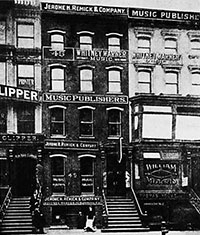
At the turn of the twentieth century, the term "Tin Pan Alley" began to appear in the popular music industry. Dozens of music publishers had settled on 28th Street between Fifth Avenue and Broadway in New York, and this district of music publishers became known as Tin Pan Alley. There are many stories suggesting the origins of the name "Tin Pan Alley." For example, when journalist Monroe Rosenfeld went to 28th Street to gather material for an article on popular music for the New York Herald, songwriter Harry Von Tilzer was working on a tune. Tilzer had put strips of paper between the piano strings to get a special metallic sound, which Rosenfeld heard and got the idea for the title of his article, "Tin Pan Alley."
Another story suggests that the district was so noisy, filled with singers, pianists, song pluggers (musicians who would perform samples of the music for interested patrons), and promoters, that the entire area sounded as if someone was banging on a tin pan. Regardless of the source of the name, Tin Pan Alley was a critical part of early American popular music.
Tin Pan Alley songwriters continued to write sheet music much like composers such as Foster and Winner had done during the nineteenth century, but there was a difference in the marketing strategy in Tin Pan Alley. Tin Pan Alley publishing companies not only promoted their sheet music by advertising, but they also focused on a very specific type of promotional strategy: vaudeville performers. Vaudeville shows were a popular form of entertainment at the turn of the twentieth century, featuring hours-long variety shows with singing, dancing, comedy sketches, acrobatics, and skits. Vaudeville was the dominant form of live entertainment in the late 1800s and early 1900s. Publishing companies often worked out deals with vaudeville singers: in exchange for performing a new tune during the vaudeville show, the performer was guaranteed his picture on the cover, a portion of the profits, or even gifts or bribes such as money or fine cigars.
The first major hit from Tin Pan Alley was "After the Ball ♫" (1892), composed by Charles K. Harris. "After the Ball ♫" exemplifies many aspects of the Tin Pan Alley song of the time. It was a lengthy ballad on the topic of lost love. True to the Tin Pan Alley marketing strategies, Harris knew he had a hit on his hands and paid a popular vaudeville singer to perform the song during all of his performances. He paid the singer $500 and offered him a share of the song’s profits, thereby ensuring that "After the Ball ♫" would be sung in every performance. The song was an instant hit—audiences frequently asked the performer to repeat it three, four, or five times during each performance. "After the Ball ♫" became a smash hit for sheet market sales, selling over five million copies of sheet music during the 1890s. Harris’s simple, catchy, sentimental song and his marketing strategy created the model for Tin Pan Alley composers of the next decades to follow.



