
Overview
Objectives
- Examine some of the musical characteristics of the earliest rock and roll hits and how these musical genres relate to earlier genres studied in the previous lessons such as blues, gospel music, rhythm and blues, and hillbilly music
- Describe the technological changes and its impact in the music industry
- Examine the influence of disc jockey Alan Freed
- Identify various rhythm and blues artists
- Examine some of the ways that white artists modified the music of black artists in their cover versions
Cover Versions
Teenagers may have loved rhythm and blues lyrics such as "I got a girl named Sue, she knows just what to do" (from Little Richard’s "Tutti Frutti ♫") and "You’re wearin those dresses, the sun comes shinin’ through / I can’t believe my eyes, all of this belongs to you" (from Big Joe Turner’s "Shake, Rattle, and Roll ♫"), but parents, record companies, and radio stations were less than impressed. In response, white artists and record companies began releasing cover versions of black artists’ songs. In general, a cover versiona song that is re-recorded by another artist refers to a song that is re-recorded by another artist. During the age of early rock and roll, however, these cover versions had a very specific purpose: to modify black artists’ rhythm and blues songs in order to make them more appropriate for white audiences.
The sexual references in the original black version were muted, modified, or deleted entirely. The black artists delivered all those sexual innuendoes in jest, with whimsical good humor. Double entendres and playful, metaphoric lyrics were common in rhythm and blues, but white record executives interpreted them as devious, overtly sexual, and thus unfit for white audiences’ consumption. Recordings by the squeaky-clean white singer Pat Boone exemplify the goals of early cover versions. Boone’s covers of "Ain’t That a Shame ♫" and "Tutti Frutti ♫" were highly sanitized versions of the black rhythm and blues originals, but they achieved far more commercial success than the original songs that Boone was covering, at least during the 1950s.
Another success story among cover artists was Bill Haley. Bill Haley often claimed to have invented rock and roll, but this claim is hardly reputable. Haley was, however, one of the first artists to achieve commercial success with crossover versions of rhythm and blues songs. During his musical career, Haley was first a country yodeler, then disc jockey, then leader of The Four Aces of Western Swing, later called The Saddlemen. They played country and western music. In 1951, Haley did a cover of Jackie Brenston’s blues release, "Rocket 88 ♫," and though the recording sold only a few copies, Haley’s live performances of the tune drove his white teenage dancers wild.
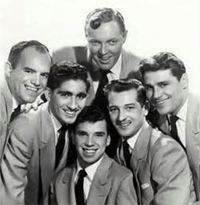
In response, he renamed his group Bill Haley and The Comets, and he set out to create a new rhythm and blues image for his band. He signed with Decca Records in 1954, and his band promptly covered Sunny Dae’s 1952 "Rock Around the Clock ♫" and Big Joe Turner’s 1954 "Shake, Rattle, and Roll ♫." "Rock Around the Clock ♫" was of only modest interest until it appeared in the movie The Blackboard Jungle; after its appearance in the film, it spent forty weeks in the top ten.
Comparing the cover version of "Shake, Rattle, And Roll ♫" by Bill Haley and His Comets (1954) with the original version by Big Joe Turner (also 1954) reveals how white rock and roll cover versions of black songs worked. In the cover version, suggestive lyrics such as "you’re wearin’ those dresses, the sun comes shinin’ through" are scrubbed into "wearin’ those dresses, your hair done up so nice." Despite this modification of the lyrics, Haley consciously modeled his musical style on that of black musicians, Louis Jordan in particular. According to Haley’s producer, Milt Gabler, "We’d begin with Jordan’s shuffle rhythm. You know, dotted eighth notes and sixteenths, and we’d build on it. They [Bill Haley and His Comets] got a sound that had the drive of the Tympany Five and the color of country and western." The 12-bar blues verses of "Shake, Rattle, And Roll ♫" combined with the country and western background of Bill Haley’s band led to a definitive sound for these early crossover hits.



"Before music, Chuck Berry worked as a carpenter, a freelance photographer, auto plant janitor, and hairdresser."
