
Overview
Objectives
- Examine the defining musical characteristics of rockabilly and consider how artists combined different genres of music to create a new style
- Examine the shift in rock and roll that occurred at the end of the 1950s, often marked by "The Day the Music Died"
- Identify various rockabilly music artists and defining characteristics of their musical styles
Buddy Holly and the Crickets
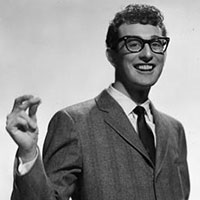
Buddy Holly began recording slightly later than Lewis, Cash, Perkins, and the other artists discussed so far in this lesson. As a result, his music shows equal influences of rockabilly and the emerging genre of rock and roll. Holly’s music combined the rhythms of rhythm and blues with the country twang of rockabilly. Holly was also one of the few rockabilly artists of the 1950s who did not get his start at Sun Records. Instead, he shuffled around labels, eventually stopping at Brunswick Records.
Born and raised in Texas, Buddy Holly made several attempts to record commercially successful music.
A talent scout recommended Holly to Decca Records in 1956, and he went to Nashville three times that year to record. The recordings Holly made in 1956 did not make the charts, but he was now determined to make successful recordings. He formed a band called the Crickets, which included Holly on vocals and lead guitar, Niki Sullivan on rhythm guitar, Joe Mauldin on upright bass, and Jerry Allison on drums. The Crickets used the standard rockabilly instrumentation of two guitars, bass, and drums. In this setting, one guitar plays lead and the other guitar plays rhythm. The lead guitar the featured guitar, which plays melodies, fill passages, solos, and riffs plays melodies, fill passages, solos, and riffs within the song’s structure; the lead is usually the featured guitar. In contrast, the rhythm guitar the supporting guitar which provides the harmony as well as a sense of rhythmic population provides the harmony as well as a sense of rhythmic population. The group’s guitars were electric, and Holly’s had a solid body, both of which were different from many rockabilly bands of the time. Holly was one of the first rock and roll guitarists to play a solid-body electric guitar—Bill Haley’s hollow-body electric guitar was common in country and western bands, and other rockabilly singers of the time often played steel guitars. The solid body of Holly’s electric guitar gave it a more aggressive tone quality compared to acoustic steel guitars or hollow electric guitars. Within a short space of time, the solid-body electric guitar became the standard guitar for rock and roll bands.
Allison played a different role than other rockabilly drummers had, often incorporating subtle Latin rhythms into his drum patterns, gestures which were unusual for the rock music of the time. Other than the fact that Mauldin played a stand-up acoustic bass and not a bass guitar, the Crickets’ instrumentation was the same as that used by many later rock groups, including the Beatles and the Rolling Stones. Holly had a distinctive playing style, strumming full chords on the electric guitar in order to create a sense of openness. His twangy voice made no mystery of his West Texas roots, and his vocal hiccups in the middle of words became a trademark of his vocal delivery style. Holly and his band enjoyed significant crossover success with rhythm and blues audiences.
Unlike a number of other rockabilly artists such as Elvis and Jerry Lee Lewis, Holly wrote almost all of his own songs. Holly and Perry experimented in the studio, utilizing different forms of echo ("Peggy Sue ♫") and double-tracking ("Words of Love ♫"). The use of double-trackingtwo nearly-identical recordings of the same vocal or instrumental track are placed on top of each other to create an enhanced effect was particularly significant. In double-tracking, two nearly-identical recordings of the same vocal or instrumental track are placed on top of each other to create an enhanced effect. This technique can be heard in the Holly’s vocal line during "Words of Love ♫." Holly’s distinctive hiccupping vocal style, his skinny build, and his black horn-rimmed glasses gave him an immediate and unmistakable identity. As a singer-songwriter with a definitive look and style, Holly set the precedent for rock artists for the next decade. The Beatles chose an insect-related name for their band in honor of the Crickets, and their instrumental lineup and early vocal styles were modeled on those of Buddy Holly and the Crickets.
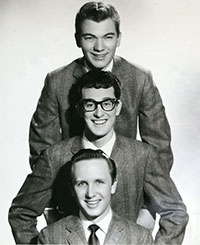
"That'll Be The Day ♫" (1957) was the first hit Buddy Holly and the Crickets released. The song is in verse-chorus form, but during the instrumental break, the band plays a 12-bar blues pattern. Holly’s riff-based and edgy lead guitar style reveals the influence of Chuck Berry, and his vocal delivery incorporates as many blue notes as hiccups, demonstrating the equal presence of rhythm and blues and country and western styles. Today, the song may sound unmistakably country, but when it was released, it was a major rhythm and blues hit. In fact, Buddy Holly was the only major rockabilly artist who never had a record on the country and western charts. So racially ambiguous was his music at the time that Buddy Holly and the Crickets were booked into the Apollo Theater (a venue devoted to African American music), sight unseen.



Eddie Cochran toured England in 1960; One of the attendees was George Harrison, prior to Beatles fame. Cochran died in a car accident on his way to catch a flight back to the States April 17, 1960.
