
Overview
Objectives
- Recall the origins and early career of the Beatles, focusing on their career until about 1966
- Recall the stylistic, personnel, and management changes of the Beatles before settling into the image of the Fab Four in matching suits
- Describe the musical style of the Beatles from this early period and how they recorded their albums.
Becoming the Beatles (Continued)
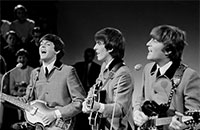
When Decca Records rejected his group, Epstein went to his friend George Martin, who was a recording engineer with the EMI label. He landed a routine new act contract: one year and four songs, one cent per single, and six cents per album. In September of 1962, Epstein listened to the first joint effort between Martin and the Beatles, liked what he heard, and hired Tony Barrow to arrange for marketing and distributing the release. "Love Me Do ♫" and its B side, "P. S. I Love You ♫," succeeded modestly in the UK, reaching No. 17 on the British pop charts.
Encouraged, Epstein and Martin set up another recording session for November of 1962. For the November session, Martin insisted that Pete Best needed to be fired and replaced with another drummer. Richard Starkey was hired away from Rory Storm and the Hurricanes and became the Beatles’ permanent drummer. The six magic components of an unparalleled musical team were now in place: John, Paul, George, Ringo, Brian Epstein, and George Martin.
George Martin followed the single "Love Me Do ♫" with the full-length album Please Please Me, which was released in March of 1963. Recorded at EMI’s Abbey Road Studios, Please Please Me is a close representation of how the Beatles’ live shows sounded at the time. The entire album was recorded on a single day, and the final cuts included very few edits or overdubs. Of these recordings, George Martin has said, "It was a straightforward performance of their stage repertoire—a broadcast, more or less." The album was a mix of Lennon-McCartney songs, such as "I Saw Her Standing There ♫" and "Do You Want to Know a Secret ♫," and cover versions of American tunes, most notably the Isley Brothers’ "Twist and Shout ♫." "Twist and Shout ♫" was the last recording made that day, but it was captured in a single take.
Their second studio album, With the Beatles, was also released in 1963. Like Please Please Me, With the Beatles shows the group’s careful study of many different types of American popular music, including rock and roll, girl groups, Motown, and rhythm and blues. They included covers of several American songs and styles that have been discussed in earlier lessons, including "Money (That’s What I Want) ♫" (written by Berry Gordy of Motown) and "Chains ♫" (written by Carole King and Gerry Goffin). With the Beatles also includes a number of Lennon-McCartney originals, such as "All My Loving ♫" and "It Won’t Be Long ♫."
Epstein arranged radio, television, and tour appearances to publicize the group and its record releases. Before long, the Beatles skyrocketed to the top of the British pop music charts. In October of 1963, the Beatles performed at the London Palladium while fifteen million television viewers watched and thousands of fans struggled to get in. As the hysteria for the Beatles and their music grew in Britain, Epstein traveled to New York in 1963 and began coordinating the group’s first trip to the United States.



"The Beatles' group name was a play on "The Crickets," who were Buddy Holly's backup band. John Lennon liked how both names had double meanings: they were both names of insects, while cricket is a popular international sport and "beat" is a musical term. When The Beatles finally met members of The Crickets, they were surprised to learn that they never thought of their band name as having anything to do with the sport - they don't play cricket in America."
