
Overview
Objectives
- Identify three different intersections of psychedelic rock with other genres of music
- Recall how Jefferson Airplane created a radio-friendly hybrid of folk rock and psychedelic rock
- Recall how Cream integrated psychedelic effects into their blues revival style
- Examine how Jimi Hendrix combined psychedelia, blues, and experimental techniques and effects in his recordings and in his live performances
Psychedelic Rock, Folk Rock, and the AM Single Format
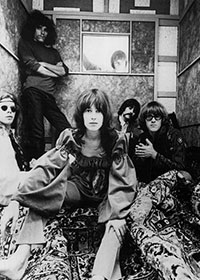
In January of 1967, the city of San Francisco was home to the Human Be-Ina gathering in San Francisco in 1967 that attracted thousands of members of the counterculture who listened to poetry, music, and shared their values, which was held in Golden Gate Park. The Human Be-In brought together thousands of members of the counterculture. Focusing on ideas such as higher consciousness, radical politics, and personal empowerment, the participants gathered to hear poetry and music and to share space with others who shared their values. Timothy Leary, the author of The Psychedelic Experience, set the tone for the Human Be-In when he uttered the famous phrase, "Turn on, tune in, drop out." The music was provided by several San Francisco bands, including the Grateful Dead, Quicksilver Messengers Services, and Big Brother and the Holding Company (which included Janis Joplin on lead vocals).
We will return to the San Francisco scene in some detail in the next lesson. At present, we will focus on the group that headlined the Human Be-In: Jefferson Airplane.
Jefferson Airplane was founded by Marty Balin in 1965. Inspired by the new folk rock style of the Byrds and Simon and Garfunkel, Balin wanted to create his own band that could play this new style of music. He purchased a pizza parlor in San Francisco and turned it into a music club called the Matrix. The first member to join the group was guitarist Paul Kantner. After adding guitarist Jorma Kaukonen, bassist Jack Casady, drummer Spencer Dryden, and singer Signe Anderson, the group signed a recording deal with RCA-Victor. They almost immediately ran into problems with RCA because their lyrics made no secret of their references to psychedelic drugs. For example, "Runnin’ Round This World ♫," which was the B-side of their first single, includes the line "the nights I’ve spent with you have been fantastic trips," and RCA was not pleased. Their first album, Jefferson Airplane Takes Off, was released in late 1966. By the time the record was released, however, singer Signe Anderson had left the band and been replaced with Grace Slick.
Slick’s talents as a singer and songwriter helped propel Jefferson Airplane to fame. The group’s first album with Slick was 1967’s Surrealistic Pillow. The album’s name was supplied by Jerry Garcia of the Grateful Dead, who said, "The album is as surrealistic as a pillow is soft." The music of this album had a harder edge than earlier recordings by the group, and it also focused increasingly on open forms and instrumental improvisation. Surrealistic Pillow featured two of the band’s best-known songs, "Somebody to Love ♫" and "White Rabbit ♫," both of which were penned by Slick. In these and other singles, Jefferson Airplane was able to capture elements of both psychedelic rock and folk rock in radio-friendly lengths and formats.



Jimi Hendrix "was entirely self-taught on guitar. He could not read music, instead he communicated his musical visions through colors: "Some feelings make you think of different colors, jealousy is purple; I'm purple with rage or purple with anger, and green with envy...""
