
Overview
Objectives
- Identify three different intersections of psychedelic rock with other genres of music
- Recall how Jefferson Airplane created a radio-friendly hybrid of folk rock and psychedelic rock
- Recall how Cream integrated psychedelic effects into their blues revival style
- Examine how Jimi Hendrix combined psychedelia, blues, and experimental techniques and effects in his recordings and in his live performances
Psychedelic Rock, the Blues Revival, and the Avant-Garde continued
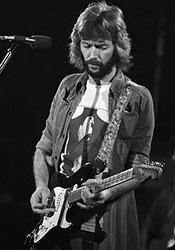
Hendrix and Clapton had similar backgrounds in the blues, and both began incorporating psychedelic effects into their music during the late 1960s. Hendrix’s psychedelic approach to the blues can be heard in "Purple Haze ♫," the second single released from Are You Experienced? Like "Sunshine of Your Love ♫," "Purple Haze ♫" is in simple-verse form and includes an instrumental bridge. As we will see, this form became commonplace in rock music because the instrumental bridge was the part of the song designated for a guitar solo. The song’s lyrics are clearly psychedelic, referring to an altered state of reality:
Purple haze was in my brain
Lately things don't seem the same,
Actin’ funny but I don't know why
Excuse me while I kiss the sky.
Although the song’s lyrics later attribute the "purple haze" to a woman, the haze could just as easily have been caused by a drug trip. "Purple Haze ♫" also incorporates significant amounts of dissonancewhen several pitches that sound as if they do not belong together are played at the same time, which can be described as pitch groupings that sound as if they do not belong together. For example, intervals such as a major third or a perfect fifth are consonant, but intervals such as a major second or a minor seventh are dissonant. Hendrix maximized the amount of dissonance in his performance by playing as many clashing notes together at one time that he possibly could.
In 1969, the members of the Jimi Hendrix Experience parted ways. Hendrix continued to perform and record with many different musicians, and he continued experimenting with new sounds and styles. In a subsequent lesson, we will consider Hendrix’s legendary performance of "The Star-Spangled Banner ♫" at Woodstock. He died of a drug overdose in September of 1970, only one year after the Jimi Hendrix Experience had broken up and only four years after he had begun to achieve mainstream success as a recording artist.
It is also important to note here that Jimi Hendrix was the first famous black rock guitarist to achieve mainstream success in over a decade. By the late 1950s, rock and roll had become dominated by white artists, whether they were rockabilly bands like Buddy Holly and the Crickets, cover and rhythm and blues artists such as Elvis Presley, or commercial pop artists like Frankie Avalon. Although rock artists such as Eric Clapton, the Beatles, the Rolling Stones, and the Beach Boys honored and were deeply indebted to the black rock and roll artists of the 1950s, rock was almost entirely made up of white musicians by the end of the 1960s. Hendrix was a rare and remarkable exception to this rule.



"A "jefferson airplane" was a slang term in the '60s for a roachclip made by splitting the paper of a paper match in half lengthwise."
