
Overview
Objectives
- Recall the significance of the San Francisco scene and the Kesey acid tests in order to understand why the Bay Area became home to the burgeoning psychedelic music movement
- Examine the eclectic musical style of the Grateful Dead, who are generally regarded as the most important Bay Area band from this period
- Examine the music of Donovan, whose gentle, folk-inspired delivery and utopian worldview spoke to many members of the countercultural movement
- Examine the music of the Doors, who represented the darker side of psychedelic music
The Darker Side of Psychedelic Rock
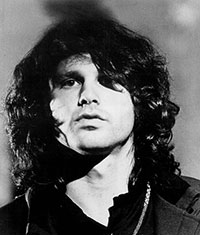
If Donovan was the sunny optimist of the psychedelic music scene, then Jim Morrison and the Doors represented the music’s dark side. Morrison, the vocalist and leader of the Doors, started the band in 1965, while he was enrolled in the film department at UCLA. Morrison first joined up with keyboard player Ray Manzarek, and Manzarek then recruited jazz drummer John Densmore and guitarist Robbie Krieger. The name of the group came from a line in a poem by eighteenth-century poet William Blake: "There are things that are known and things that are unknown, in between the doors." Aldous Huxley used the line for the title of his book on mescaline experimentation, The Doors of Perception.
The music of the Doors was dark, blues-based psychedelic rock, and their lyrics focused on death, violence, and a menacing kind of sex. Morrison’s lyrics were evocative and often terrifying. Unlike bands and artists who recorded music about new states of reality or utopia, Morrison and the Doors tended to focus on the results of a bad trip. For example, "The End ♫" is almost twelve minutes long, and toward the end Morrison screams about oedipal desires. Morrison spoke openly about the madness and terror of his music and of his own mind. In an interview, Morrison explained, "Sometimes the pain is too much to examine, or even tolerate. Life hurts a lot more than death. At the point of death, the pain is over."
The group’s first single, "Break on Through (To the Other Side) ♫" was not particularly successful at the time of its release; it only went to number 126 on the American pop charts. Regardless, it was one of the band’s concert staples, and it has become one of their most popular songs. Densmore’s drum line is inspired by Brazilian Bossa Nova rhythms, and the song’s bass line is also inspired by Bossa Nova. Manzarek’s imperfect organ solo suggests the Doors’ dystopian worldview. Finally, Morrison’s lyrics make no secret of the use of drugs: "Everybody loves my baby / she get, she get, she get, she get high.
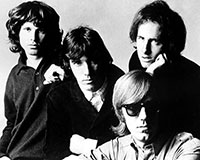
" Although not as dark as some other singles, "Break on Through (To the Other Side) ♫" represents the Doors’ uniquely disturbing point of view.
Morrison’s erratic behavior both on and off the stage drew the admiration and fascination of fans. In 1967, teenage magazines gushed over Morrison as the latest heartthrob, but at the same time, he was frequently arrested on charges such as lewd and lascivious behavior, public drunkenness, indecent exposure, and public profanity. Morrison died in 1971, most likely either from a drug overdose or from complications due to years of drug addiction. Three weeks after Morrison’s death, the Doors released their final hit single, "Riders on the Storm ♫."



The Doors have six songs in the 1994 movie Forrest Gump (more than any other band): "Soul Kitchen", "Hello I Love You", "Break On Through (To The Other Side)", "Peace Frog", "People Are Strange", and "Love Her Madly."
