
Overview
Objectives
- Recall the significance of three outdoor music festivals: the 1967 Monterey International Pop Festival, the 1969 Woodstock Music and Art Fair, and the Altamont Speedway Free Festival, also held in 1969
- Examine how these three events capture the best and worst aspects of the music and culture of the late 1960s
- Recognize these three festivals both as musical events as well as cultural events in order to understand why they were so significant for both rock music as well as for the culture in general
The Woodstock Music and Art Fair continued
Another political statement at Woodstock was delivered by Country Joe McDonald of the band Country Joe and the Fish. At Woodstock, Country Joe performed a solo version of his band’s most famous song, "I-Feel-Like-I’m-Fixin’-To-Die-Rag ♫." The song is also known as the "Vietnam Song" because it offers a scathing critique of the Vietnam War. At first listen, "I-Feel-Like-I’m-Fixin’-To-Die-Rag ♫" sounds like a catchy recruitment tune, but the lyrics are bitingly sarcastic. In the song, the band questions the purpose of the Vietnam War and criticizes the draft. Parents are encouraged to be the first on their block whose son comes home from the war in a pine box.
Each chorus encourages ignorance and promises death:
What are we fighting for?
Don’t ask me, I don’t give a damn
Next stop is Vietnam.
Five, six, seven
Open up the pearly gates,
Well there ain’t no time to wonder why
Whoopee! We’re all going to die.
McDonald had not been on the original roster of performers, and his performance at Woodstock was impromptu. He opened the performance by engaging the audience with a version of what his band called the "fish cheer": "Give me an F / F / Give me an I / I / Give me an S / S/ Give me an H / H / What does that spell? Fish!" By the time of Woodstock, however, the band rarely did the "fish cheer" any more; instead, they and their audience opted to spell another four-letter word that began with the letter F.
Only four female performers appeared at Woodstock: Melanie Safka, Joan Baez, Grace Slick, and Janis Joplin. Joplin had left Big Brother and the Holding Company at the end of 1968, and in 1969, she released her first solo album, I Got Dem Ol’ Kozmic Blues Again, Mama! At Woodstock, Joplin sang a mixture of her solo works—including "Kozmic Blues ♫" and "Work Me, Lord ♫"—and songs that she had recorded with Big Brother and the Holding Company—such as "Ball and Chain ♫" and "Piece of My Heart ♫." Joplin was both intoxicated and under the influence of heroin during her performance. She announced to the audience that she was "three sheets to the wind" and repeatedly asked if everyone was staying stoned. She managed to perform her set, although recordings reveal that she was hoarse and her voice frequently cracked. Her raw performance style was echoed in her lifestyle, and she died of a drug overdose only a year after her appearance at Woodstock.
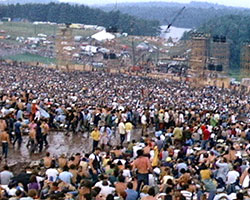
Together, Joplin, Country Joe, and Hendrix represent a cross-section of the music performed at Woodstock. Artists of international repute played alongside those who were famous only regionally. Some songs were about love, others were blatant political statements, and yet others were psychedelic works of art. The sense of peace, love, and cooperation at Woodstock were as emblematic as the images of mud-soaked concertgoers.



"The four-hour film “Woodstock” won the Best Documentary Oscar in 1970.Since then, it has been re-released several times with added concert footage and extras. The film was directed by Michael Wadleigh, who tapped young filmmaker Martin Scorsese to be an assistant director and film editor Thelma Schoonmaker to be supervising editor. Scorsese and Schoonmaker have remained a director/editor team to this day, and Woodstock was their film together."
