
Overview
Objectives
- Recall the significance of several predecessors of progressive rock, such as the Who, the Moody Blues, and Procol Harum, all of whom integrated rock and classical music
- Identify the key groups of the prog rock movement, including King Crimson, Yes, and Emerson, Lake, and Palmer
- Recognize several defining factors of prog rock, including virtuosic performing, classical or classically-inspired instrumentation, prominence of keyboard instruments, spiritual themes, experimental forms, and the importance of concept albums
Prog Rock Comes of Age
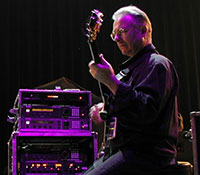
In the Court of the Crimson King, recorded in 1969 by King Crimson, is the first major progressive rock album. It established a formula that prog rock musicians would follow for decades. The album features Robert Fripp on guitar, Michael Giles on drums, Greg Lake on bass and vocals, and Ian McDonald on a number of instruments, including flute, clarinet, saxophone, vibraphone, and keyboards. McDonald also played the Mellotron a precursor to the synthesizer that could play back recorded sounds of a variety of instruments, an instrument that could play back recorded sounds of a variety of instruments.
The Mellotron was a precursor of the synthesizer and the sampler because it allowed the musician to play a keyboard and produce the sounds of instruments such as strings, trumpets, or flutes. By using the Mellotron, McDonald was able to create the illusion that a symphony orchestra (or at least some of its instruments) was playing in the studio with King Crimson. The music frequently included asymmetrical meters and jagged rhythms, as well as lengthy sections of instrumental playing. The angular melodies in King Crimson’s music reflect a combination of influences from twentieth-century classical music as well as modern jazz. King Crimson underwent a number of personnel changes during the 1970s, and over the life of the group, Fripp is the only original member who remains.
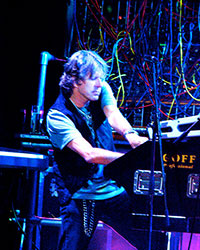
Bassist and singer Greg Lake left King Crimson in 1970. Lake, keyboardist Keith Emerson, and drummer Carl Palmer formed the progressive rock supergroup Emerson, Lake, and Palmer (or ELP for short). Emerson had established a reputation by playing with the band Nice, and he also had training as a classical pianist. Following Jimi Hendrix’s example, Emerson would often destroy his keyboards during his performances. His virtuosic performance skills and his innovative rock arrangements of classical music helped established ELP as one of the most definitive groups of the prog rock movement.
In 1971, ELP released two albums that demonstrate several key aspects of their style.
Pictures at an Exhibition was a live album of a performance the trio had given at Newcastle City Hall. The album was ELP’s rock arrangement and reimagining of the classical suite Pictures at an Exhibition, a piece that was composed by Modest Musorgsky during the nineteenth century. In addition to arranging the original piece for their trio to perform, ELP also interpolated entirely new movements as well as new sections within existing movements of the piece. Their unique treatment of an orchestral piece, as well as Emerson’s use of classical keyboard instruments such as a pipe organ, represents one side of the prog rock movement.
ELP’s second 1971 album, Tarkus, is a studio album of music written entirely by the band. The first side of the album, "Tarkus ♫," is a twenty-minute instrumental depiction of Tarkus (a part-armadillo, part-tank pictured on the album’s cover) who battles a series of creatures such as a manticore and an underwater version of himself. In the spirit of classical music, the "Tarkus" side of the album was called a suite, a term usually reserved for multi-movement classical music pieces. The second side of the album is a series of singles with lyrics. Emerson plays a variety of keyboards, ranging from a church organ, a celesta, and a piano to much more modern keyboard instruments such as a Hammond organ and a Moog synthesizer an analog synthesizer; an electronic music system whose sounds are played on a keyboard. The Moog (pronounced "mohg") synthesizer is an electronic music system whose sounds are played on a keyboard; the instrument was first made famous by composer Wendy Carlos, who used the instrument to record 1968’s Switched-On Bach. On the two albums Tarkus and Pictures at an Exhibition, ELP demonstrated their simultaneous grasps of rock music and classical music, offering two exemplars of early progressive rock.



"The drum kit Carl Palmer played in concert cost $25,000 to make. It had a xylophone, tympani, and gong."
