
Overview
Objectives
- Examine the relationship between music and the American civil rights movement during the 1960s
- Identify characteristics of Brown’s musical style from this period
- Identify some of the defining features and characteristics of funk music
- Recall the significance of Sly and the Family Stone in the development of funk music
- Examine the role George Clinton played in funk music during the 1970s with P-funk genre
- Examine how popular media such as Blaxploitation films and television programs helped promote African American music and musicians
James Brown
In the late 1960s, Brown began recording songs that promoted black pride and empowerment. Not only were the songs popular, but the lyrics and titles contained messages that encouraged African Americans to embrace the ideas of community and empowerment. Songs such as "I Don’t Want Nobody to Give Me Nothing (Open Up the Door, I’ll Get it Myself) ♫" (1969) and "Get Up, Get Into It, Get Involved ♫" (1970) are just a few examples. In "Say It Loud—I’m Black and I’m Proud ♫" (1968), Brown engages in call and response with the backup singers. Throughout the song’s choruses, Brown shouts, "Say it loud!" and the other voices reply, "I’m black and I’m proud!" During the song, Brown does not sing lyrics. Instead, he delivers a spoken message that sounds more like a fiery sermon than a sung verse.
Brown frequently makes reference to gospel songs and messages.At one point, he says, "We’ve been ‘buked, and we’ve been scorned," which is the name of a popular gospel hymn. "Say It Loud—I’m Black and I’m Proud ♫" quickly became an anthem among advocates of black pride.
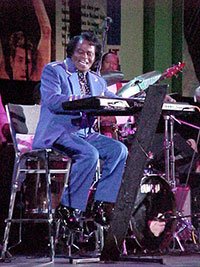
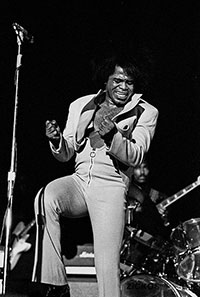
The lyrics of Brown’s music were inspiring, but his message was amplified through his performance style. During his songs, Brown would grunt, shout, scream, and wail, all of which were rhetorical gestures of gospel music and gospel preaching styles. Like a gospel preacher, during his live shows, Brown would build to a fever pitch toward the end of his show. He would collapse to the stage, ostensibly from exhaustion, and he would be covered with a cape and led off the stage. Brown, much to the audience’s delight, would throw off the cape and return to finish the number and the show.
Although Brown was an important spokesperson for the Black Power movement, not all of his music was about black empowerment.
Songs such as "Papa’s Got a Brand New Bag ♫" (1965) is about a man who has mastered every dance craze, such as the Mashed Potato, the Jerk, and the Fly. "Cold Sweat ♫" (1967) is an ode to the cold sweat that is brought on by a woman’s appearance and touch. Brown was able to balance his messages between those of those of "Get Up (I Feel Like Being a Sex Machine) ♫" and "Get Up, Get Into It, Get Involved ♫," both of which were released in 1970.

“Soul music is true to its name. It's music that connects to your soul, your spirit. When music resonates with people's spirit like that, when people can emotionally connect with something or it helps to heal them, transform them, that never goes out of style. People will always need something to relate to.”

“Blues and soul and jazz music has so much pain, so much beauty of raw emotion and passion.”

"Throughout the 1940s and early 1950s, [Sam Cooke] gained acclaim as a member of gospel harmony groups, including the Highway Q.C.s and the Soul Stirrers. At the time, the Soul Stirrers were considered the most respected gospel singing group in the US."
