
Overview
Objectives
- Recall the development of MTV during the 1980s
- Examine the significance of the Second British Invasion as it related to MTV
- Examine the role Michael Jackson played in eliminating the color lines on MTV
- Recall how Madonna pushed musical and visual boundaries in her music and videos
Race and MTV: The Case of Michael Jackson
African American music and musicians were conspicuously absent from MTV. The only African American musician whose music was played with any regularity was Donna Summer, and even then, her music video for "She Works Hard for the Money ♫" (1983) was played in light rotation. MTV drew heavy criticism for their rejection of black musicians, but MTV executives repeatedly claimed that black music was not consistent with the format of the station. Repeatedly, MTV executives and veejays claimed that they did not play black artists’ music because their station was dedicated to "rock and roll."
Of course, they then heavily programmed Phil Collins’s note-for-note cover of the Supremes’ "You Can’t Hurry Love ♫" and did not air the music of any Motown artists. Additionally, the lines of genres had blurred so much by the early 1980s that it was increasingly difficult to explain how the music of the Eurythmics was "rock" but the music of Donna Summer was not.
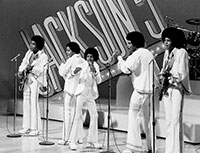
The musician who broke down MTV’s color barriers was Michael Jackson. As the lead singer of the Jackson 5 during the late 1960s and 1970s, Jackson had already demonstrated his crossover appeal. His first solo album, 1979’s Off the Wall, was a huge hit and signaled his shift from child star to adult pop artist. However, with the release of Thriller in 1982, Jackson shattered virtually every sales record that existed. Thriller was the number 1 album on the Billboard charts for 37 weeks, and to this date, it is the best-selling album of all time. Seven of the nine songs were released as singles, which was also unprecedented. Jackson wanted to create an album that crossed boundaries of genre and style, and he did so in a way that has yet to be replicated by any other artist.
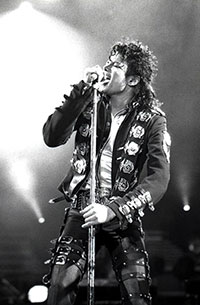
Thriller, produced by Quincy Jones, contains songs that are catchy, clean, and stylistically diverse. The album was carefully calculated for broad appeal across race and age categories. The music was bass-driven and prominently featured the synthesizer. It was weightier than the New Wave pop of groups like Blondie, yet lighter than the funk of George Clinton. "The Girl is Mine ♫" was a sweet, pop-oriented duet with Paul McCartney, and "Billie Jean ♫" has an infectious dance beat with pulsing, synthesized strings and a catchy chorus. "Billie Jean ♫" was bumped from the number 1 single spot by another Jackson song, "Beat It ♫," which featured an electric guitar solo performed by Eddie Van Halen.
Jackson had enormous visual appeal as a performer. His dancing seemed superhuman at times.
When he debuted his Moonwalk dance on a live television program in 1983, the sales of Thriller spiked even higher. Jackson imparted this visual appeal into his music videos.
"Beat It ♫" was an ensemble dance number that allegedly included Los Angeles gang members in addition to professional dancers. Jackson spent $150,000 on the production of the "Beat It ♫" video, which was more than three times what most music videos of the time cost to produce. Director Steve Barron, who had a background in advertising, made the "Billie Jean ♫" video a depiction of Jackson constantly evading a detective. Jackson's character leads his pursuer through the streets, and he vanishes just as the detective was about to capture him.

“MTV essentially killed 'American Bandstand' and 'Solid Gold,' because music videos are an easier way for pop artists to gain television exposure.”

“MTV didn't exist in 1980, but by 1982, it had gotten to be a force to be reckoned with.”

