
Overview
Objectives
- Recall the development of MTV during the 1980s
- Examine the significance of the Second British Invasion as it related to MTV
- Examine the role Michael Jackson played in eliminating the color lines on MTV
- Recall how Madonna pushed musical and visual boundaries in her music and videos
Race and MTV: The Case of Michael Jackson continued
Despite the astronomical commercial success of Thriller, MTV still refused to play Jackson’s videos. Finally, the president of CBS Records threatened to pull all of its videos from MTV and boycott the station unless they played Jackson’s videos. The station finally relented in March of 1983. "Billie Jean ♫" became the first Jackson video played on MTV, and Jackson himself was the first African American musician whose music was placed in heavy rotation on the channel.
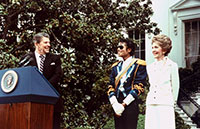
Jackson’s next project was an extended music video for the single "Thriller ♫." He hired a film director named John Landis, who had previous directed the feature film An American Werewolf in Paris. The video for "Thriller ♫" was fifteen minutes long and cost over $300,000 to produce. The elaborate makeup, special effects, story line, and choreography of the "Thriller ♫" video made it one of the most important pop culture icons of the 1980s. When the video for "Thriller ♫" aired on MTV, the station had to run it twice an hour to meet the viewers’ demands. At fifteen minutes in length, that meant half of every hour of programming on MTV was dominated by the "Thriller" video.
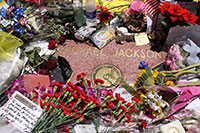
Although Jackson’s personal life until his death in 2009 was marred by personal tragedy, multiple plastic surgeries, financial struggles, and accusations of child abuse, his importance in the history of popular music and on MTV cannot be understated. Jackson’s success forced MTV to start playing the music of black artists. In his music and music videos, Jackson addressed a number of sensitive racial topics.
In "The Girl is Mine ♫," the lead single from Thriller, Jackson and McCartney fight over the same girl, thus implying the existence of interracial relationships. In the video for "Black or White ♫" (1991), Jackson and his producers employed the latest visual technology in order to morph the faces of people of different races into each other, thus implying the malleability of race.

“Michael Jackson was one of popular culture's greatest artists. Nobody danced better. Few sang more compellingly. No one understood more about stage spectacles or music videos. He was an innovator. His reach was global.”

“Watching Michael Jackson was like taking a history lesson and a lesson on the future at the same time. If that weren’t enough, Michael then went and single-handedly revolutionized music videos. It’s amazing that today, some twenty-five years later, everyone who makes a pop music video still feels obligated to include a 'group dance' sequence like the one Michael pioneered in 'Beat It'. That’s how influential and ahead of the times he was.”

